Showing posts with label sectional warp beam. Show all posts

Tuesday, June 20, 2017

Old Looms Have a Way of Finding Me

Garage full of Weaver's Friend loom parts.
My friend Joan Sheridan, shop owner of Heritage Spinning and Weaving in Lake Orion, Michigan was contacted by someone recently who wanted to find a home for an old loom. It is called a Weaver's Friend and was manufactured by the Reed Loom Manufacturing Company. Since I have gotten several old looms going again and no one else took the bait, she asked if she could bring it up to me.

It now sits on my garage floor in multiple parts.

This part attaches to the crankshaft and the lower back frame support board, and is cracked enough to not be usable.
It is the board in the center of this whole assembly of crankshaft, pitmans, and back support board.
Bob thought the design might not have been strong enough for the force on it, so he beefed it up a bit when he cut a new one. He also made holes for the washers at an angle so they would be perpendicular to the bolts instead of at an angle when everything is tightened down.
The other part of all this assembly is the support board with an arched metal piece that engages with the cog wheel in the center of the crankshaft. The pitmans are the four curvy wooden parts (two are shown in the photo above) and connect with the bottoms of the shafts. It all becomes the automated part of the loom to raise and lower the shafts during weaving.
This is a two shaft loom.  The shafts are very heavy due to the thick hardwood frames and the cast iron pieces. The metal heddles add weight also.
Sectional warp beam.
(
(L to R) Part name?, cloth beam, front bottom brace, breast beam, and back beam.
Beater that includes a 12 dent reed.
Top to bottom: handle with pawl, sleying hook, crank handle, rag shuttle.


A few boxes of rag strips were included.

Also included was a blue chained warp and three  large cones of cotton yarn and one mystery fiber.

My hope is to get the restoration done by next week and get a warp on and threaded by the beginning of July.  If that all happens and everything is working well, it will take a trip over to the Walloon Lake Antique Flywheelers grounds to be used as a demonstration loom at the end of July.

That is all contingent on how I am feeling on any given day.  I am halfway through my chemo treatments, with my forth one scheduled next Thursday. I have four or five days of not feeling well following treatment, and am finding I am getting progressively more tired from each one. Daily afternoon naps have become part of the routine. This project has been a nice distraction.

I have started cleaning the loom and removing cast iron parts and painting them. My next post will start showing my progress.


Wednesday, March 5, 2014

Weaving The Michigan Tartan on the Weaver's Delight


I took on this experiment to satisfy my own curiosity about weaving cloth on this big fly-shuttle rug loom.  I wasn't acquainted with anyone who had done it, but I had a shuttle especially designed for the loom and yarn, so I decided to try it out.

I was using size 8/2 cotton for the warp.  I knew from previous experience that setting it at 24 ends per inch would be just right for a 2/2 twill.  The sections on the warp beam measure 2" between the pegs, so I calculated 48 ends in each section for a width of 20", equaling 10 sections.  I suspected I would end up wishing I had used 26-28 ends per section, since each peg takes up some of the width.

My pattern for the towels was the Michigan Tartan, found on the Scottish Register of Tartans,
Michigan Tartan
I used the threadcount given for the tartan, decided what was going to be at the starting edge and then made a chart noting the order and number of each color for each section.  Each section had to total 48, so some of the stripes were in two different sections.

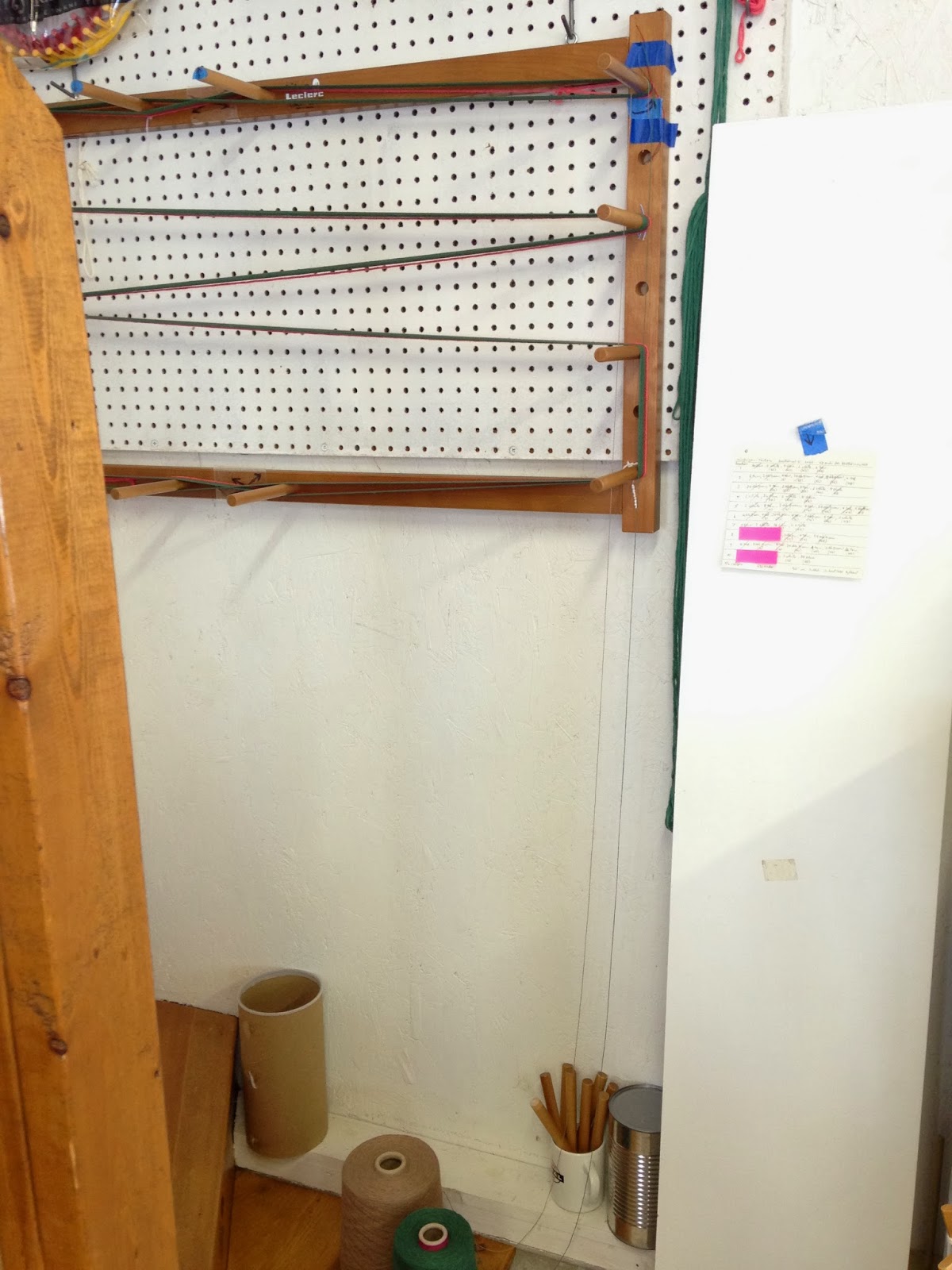
I used the bright pink post-a-notes to keep my place and crossed off each color as it was wound.
I only had one cone of each color, so I wound the colors on my warping board, one section at a time. 
As I finished each section, I took it off the board and threaded it through my tension box and wound it onto the warp beam.

I use eight pieces of plastic tubing seen on the pegs to keep the yarn from accidentally going into the sections on either side.
Frequent color changes can be aggravating without a plan.  I figured out quite a while ago that it was a waste of time to tie the color changes together at the first peg.  Now I put tape on the board and tape the beginning of each color below the peg and the end gets taped above the peg.  It makes warping much faster.
 Each section end of the warp gets taped before removing from the tension box so the threads will be in order for threading.  Here are eight of the ten sections prepared.
Before threading each section, the warp is taped to the shuttle race at the front of the loom in a handy spot for picking the next thread.

I threaded the 12 dent reed with two warp ends per space.  When I was done, I knew I was right about needing to wind 26-28 ends per section, because the warp in the ten sections was wider than in the reed.  It wasn't bad enough to do over, and besides, this was all just an experiment, with the spacing included.  Next time I will add more warp ends per section.

 I got everything tied onto the apron rod and wove a small amount to spread the warp.  Note that the lacing from the apron to the rod does not extend much past the width of the towel.  If it was laced to the ends of the rod, the towel would pull on the center and bow the rod.  Keep the lacing the same width as the weaving to avoid tension problems once weaving begins.
The first towel was just one weft color as I worked on adjusting the loom.  I had a lot of broken warp threads as I tried to adjust everything.  The shuttle kept going crooked through the shed from the right side.

I eventually ended up putting a different picker heel on that wasn't as worn as the one I started with.  It did help a lot.  All the warp breakage occurred on the first towel and the first inch of the second towel.  I got a lot of practice repairing warp threads on this big old loom!


Wednesday, July 11, 2012

Weaver's Delight Restoration - It's Looking Like a Loom!

I went to the hardware store after work today to pick up some bolts and wingnuts to attach the top of the beater.  When I got home, I found out I bought the wrong size.  I found something in the basement that will work till I get the correct hardware.

I was able to attach the other "flapper thingy" on the fly shuttle temporarily, until I get an oblong washer that needs replacing and the correct bolt that my dad is going to make for it.

The apron was another fairly simple job to tack on, once I installed the cloth beam. 

After adjusting the brackets that hold the shafts, all four of them slid in easily.
Here is the loom from the rear, showing the sectional beam that I put on tonight.  It sure is heavy!  It still needs some cross braces made, to keep the wooden bars from giving when the warp is wound on.  I will have to get measurements for that tomorrow, so Bob can get them made.

I still haven't attached the picker sticks, since I am still waiting for the new pickers and leather straps.  Hopefully, they will arrive soon.
In the meantime, I still have more to work on.  The thread rack spindles are very rusty, so I took them all off tonight.  I think I will try the navel jelly on them tomorrow, instead of vinegar.

It was getting dark out and the mosquitoes were getting annoying, so I will get the rest of the red frame cleaned up and painted tomorrow.  My favorite color!

I've started looking at some rug books for inspiration.  I will have to be deciding what my first project will be very soon.


Wednesday, July 4, 2012

Weaver's Delight Restoration - Sectional Warp Beam

None of my other looms have a sectional warp beam, so I'm glad I took a lot of photos before taking it apart.

This is straight out of the van after bringing it home from Minnesota.  It was dirty and rusty.  If anyone is going to restore one of these looms, get some orientation pictures so it can be put back together correctly.
This cast iron end is marked N6.  The wooden bar that the straps are stapled to are bolted to that section.
This end of the beam is marked N5.  The other end of the bar with the straps attaches to the N5 section.


Another thing to take a photo of is the orientation of the holes on the wooden bars.  They will all be facing the same direction.

Note the bar next to the one with the straps with buckles.  It has a heavy cord stapled to the hole side.  
It needs to be put back together in the right order for the cord to serve it's purpose, which is to hold the strap ends while winding each section. It keeps them from flopping around before each section is filled.  If your loom doesn't have the cord, it is an easy addition to make.


Before removing the straps for cleaning, I marked the center one, so I would know which direction to staple them back on.  They are stapled to the underside of the bar and wrap almost completely around the bar.  If they aren't wrapped around, the staples will tear the twill tape, and the buckle end will not end up where it is supposed to be.  The end of the buckle should be between the bar with the cord, and the one it's stapled to.
Finished N5 end.
Finished N6 end.
It feels good to have a section of the loom done.  Actually I have quite a bit of it done.  Pictures will come in another post.

Friday, June 22, 2012

Weaver's Delight Restoration - Varnishing and Painting

Sore hands again tonight.  My right thumb just doesn't like some of the things I do!  One of them is hand sanding.  These are the shaft end brackets, with the light coating of rust removed, primed, and here with a pretty coat of aluminum gloss paint.
Styrofoam works well to hold screws and bolts for painting.  These are all the screws for attaching the end brackets on the shafts.  Twelve per shaft, so with that many, I will definitely be using my cordless screwdriver.  I have one shaft ready to go, under the styrofoam.  The wood for the other three still needs another coat of varnish, so I will do that tomorrow, if the three grandchildren that will be here give me enough time.

I also got another coat of the green paint on some of the cast iron pieces I showed in the previous post.
The second coat of varnish made a lot of difference in the smoothness of the wood.  I very lightly sanded with black sandpaper after the first coat dried.  After a second coat, I sanded (just barely, with worn out sandpaper) just enough to bump off any dust, and  make the wood smooth.

This is me, starting to attach the washed twill tape strips to one bar of the sectional warping beam with an electric staple gun.
The wood was very hard, so I had to finish driving the staples into it with a hammer.

There is a right and wrong direction to attach the tapes.  Before I removed them from the bar, I made sure to mark which side of it the end of the tape needed to be. Otherwise, the straps won't wrap around the beam correctly, and the buckles on the end of the straps will hit the wood.
After I got them all attached, I wound each one around the bar and tied them down with some thrums (scrap pieces of yarn from a previous weaving project) so they don't get in the way when I assemble the warp beam.

I will show the proper direction for the tapes in a future post, when I assemble the sectional beam.

Bed is calling!