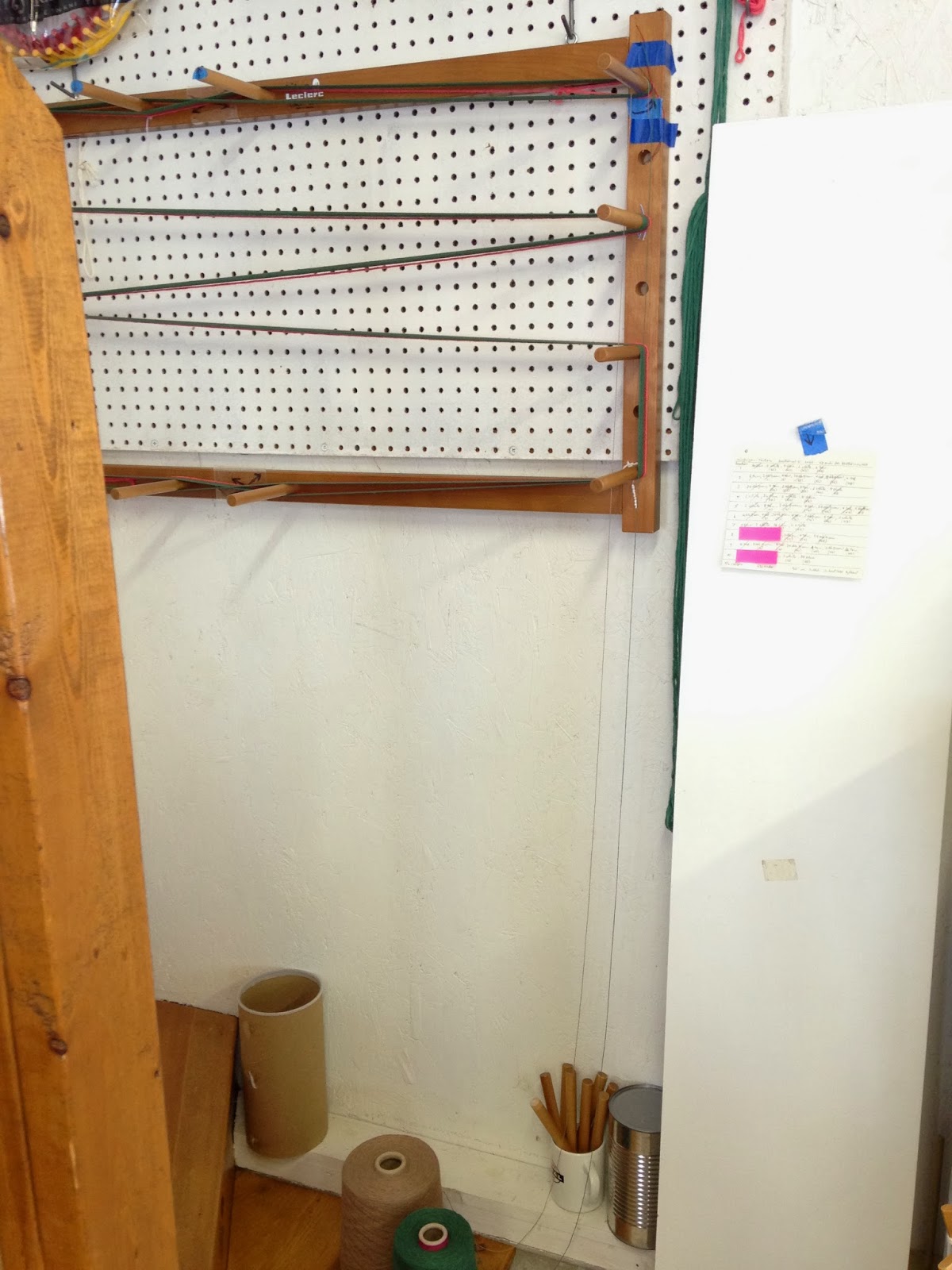
I took on this experiment to satisfy my own curiosity about weaving cloth on this big fly-shuttle rug loom. I wasn't acquainted with anyone who had done it, but I had a shuttle especially designed for the loom and yarn, so I decided to try it out.
I was using size 8/2 cotton for the warp. I knew from previous experience that setting it at 24 ends per inch would be just right for a 2/2 twill. The sections on the warp beam measure 2" between the pegs, so I calculated 48 ends in each section for a width of 20", equaling 10 sections. I suspected I would end up wishing I had used 26-28 ends per section, since each peg takes up some of the width.
My pattern for the towels was the Michigan Tartan, found on the Scottish Register of Tartans,
Michigan Tartan
I used the threadcount given for the tartan, decided what was going to be at the starting edge and then made a chart noting the order and number of each color for each section. Each section had to total 48, so some of the stripes were in two different sections.
I used the bright pink post-a-notes to keep my place and crossed off each color as it was wound.
I only had one cone of each color, so I wound the colors on my warping board, one section at a time.
As I finished each section, I took it off the board and threaded it through my tension box and wound it onto the warp beam.
I use eight pieces of plastic tubing seen on the pegs to keep the yarn from accidentally going into the sections on either side.
Frequent color changes can be aggravating without a plan. I figured out quite a while ago that it was a waste of time to tie the color changes together at the first peg. Now I put tape on the board and tape the beginning of each color below the peg and the end gets taped above the peg. It makes warping much faster.
Each section end of the warp gets taped before removing from the tension box so the threads will be in order for threading. Here are eight of the ten sections prepared.
Before threading each section, the warp is taped to the shuttle race at the front of the loom in a handy spot for picking the next thread.
I threaded the 12 dent reed with two warp ends per space. When I was done, I knew I was right about needing to wind 26-28 ends per section, because the warp in the ten sections was wider than in the reed. It wasn't bad enough to do over, and besides, this was all just an experiment, with the spacing included. Next time I will add more warp ends per section.
I got everything tied onto the apron rod and wove a small amount to spread the warp. Note that the lacing from the apron to the rod does not extend much past the width of the towel. If it was laced to the ends of the rod, the towel would pull on the center and bow the rod. Keep the lacing the same width as the weaving to avoid tension problems once weaving begins.
The first towel was just one weft color as I worked on adjusting the loom. I had a lot of broken warp threads as I tried to adjust everything. The shuttle kept going crooked through the shed from the right side.
I eventually ended up putting a different picker heel on that wasn't as worn as the one I started with. It did help a lot. All the warp breakage occurred on the first towel and the first inch of the second towel. I got a lot of practice repairing warp threads on this big old loom!