Showing posts with label sectional warping. Show all posts

Wednesday, March 5, 2014

Weaving The Michigan Tartan on the Weaver's Delight


I took on this experiment to satisfy my own curiosity about weaving cloth on this big fly-shuttle rug loom.  I wasn't acquainted with anyone who had done it, but I had a shuttle especially designed for the loom and yarn, so I decided to try it out.

I was using size 8/2 cotton for the warp.  I knew from previous experience that setting it at 24 ends per inch would be just right for a 2/2 twill.  The sections on the warp beam measure 2" between the pegs, so I calculated 48 ends in each section for a width of 20", equaling 10 sections.  I suspected I would end up wishing I had used 26-28 ends per section, since each peg takes up some of the width.

My pattern for the towels was the Michigan Tartan, found on the Scottish Register of Tartans,
Michigan Tartan
I used the threadcount given for the tartan, decided what was going to be at the starting edge and then made a chart noting the order and number of each color for each section.  Each section had to total 48, so some of the stripes were in two different sections.

I used the bright pink post-a-notes to keep my place and crossed off each color as it was wound.
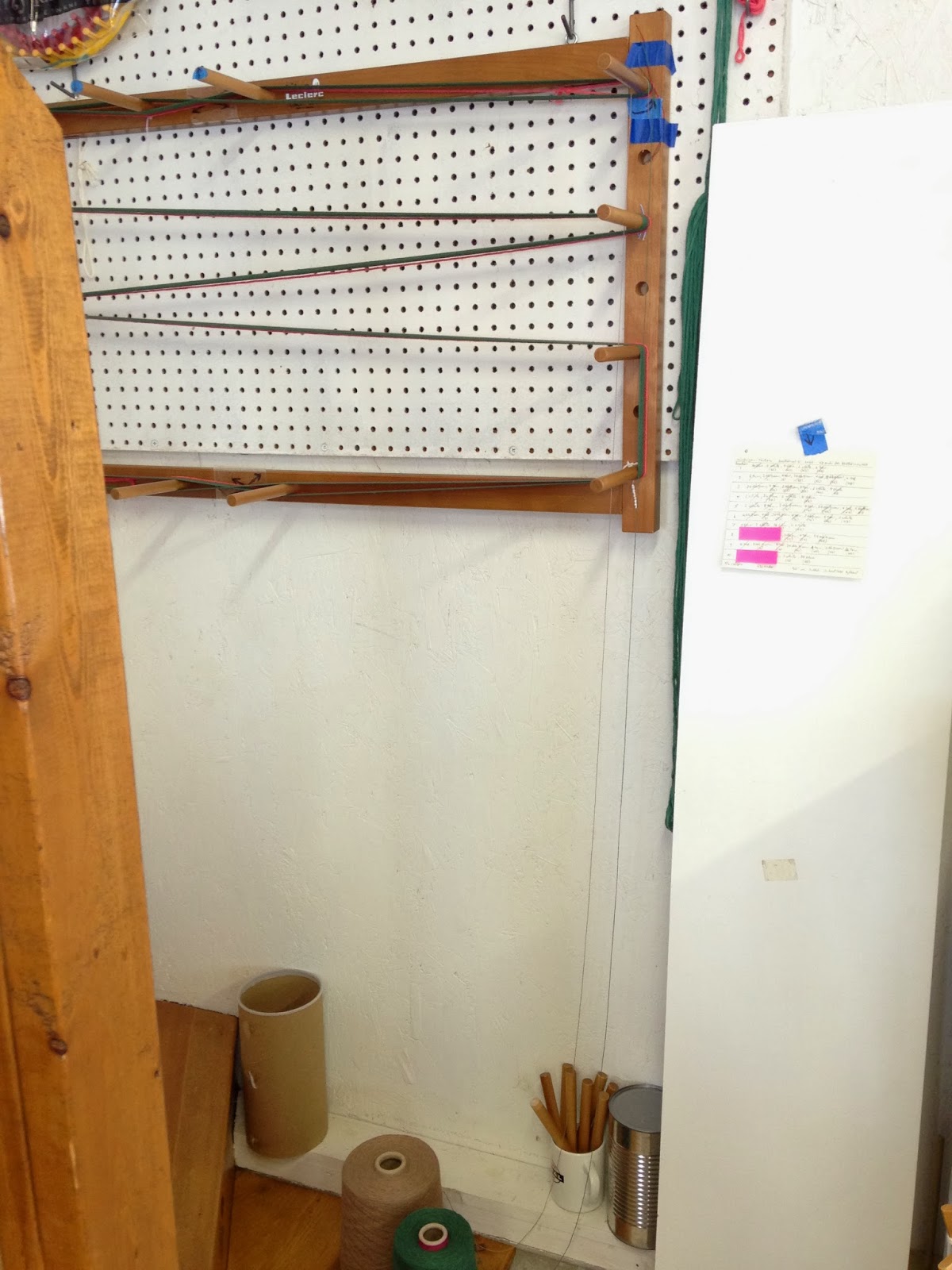
I only had one cone of each color, so I wound the colors on my warping board, one section at a time. 
As I finished each section, I took it off the board and threaded it through my tension box and wound it onto the warp beam.

I use eight pieces of plastic tubing seen on the pegs to keep the yarn from accidentally going into the sections on either side.
Frequent color changes can be aggravating without a plan.  I figured out quite a while ago that it was a waste of time to tie the color changes together at the first peg.  Now I put tape on the board and tape the beginning of each color below the peg and the end gets taped above the peg.  It makes warping much faster.
 Each section end of the warp gets taped before removing from the tension box so the threads will be in order for threading.  Here are eight of the ten sections prepared.
Before threading each section, the warp is taped to the shuttle race at the front of the loom in a handy spot for picking the next thread.

I threaded the 12 dent reed with two warp ends per space.  When I was done, I knew I was right about needing to wind 26-28 ends per section, because the warp in the ten sections was wider than in the reed.  It wasn't bad enough to do over, and besides, this was all just an experiment, with the spacing included.  Next time I will add more warp ends per section.

 I got everything tied onto the apron rod and wove a small amount to spread the warp.  Note that the lacing from the apron to the rod does not extend much past the width of the towel.  If it was laced to the ends of the rod, the towel would pull on the center and bow the rod.  Keep the lacing the same width as the weaving to avoid tension problems once weaving begins.
The first towel was just one weft color as I worked on adjusting the loom.  I had a lot of broken warp threads as I tried to adjust everything.  The shuttle kept going crooked through the shed from the right side.

I eventually ended up putting a different picker heel on that wasn't as worn as the one I started with.  It did help a lot.  All the warp breakage occurred on the first towel and the first inch of the second towel.  I got a lot of practice repairing warp threads on this big old loom!


Thursday, October 4, 2012

Tension Box for Sectional Warping

My first experience using a tension box was when Bob and I wound my first warp onto the restored Weaver's Delight loom.  I didn't own one, since none of my other looms have sectional beams, so I borrowed a homemade one from a friend. 

Now, I have a whole box of rug warp, with lots of colors, and am ready to wind on my second warp.  I gave the tension box back to my friend after putting the first warp onto the loom, so I showed Bob what I needed. 

He drew up some plans, and when I came home from work this afternoon, he had most of it completed.

I found a wire coat hanger and made the two wire gates to keep the yarn from popping out of the tops of the open reeds.

Bob finished it after school.  He picked up some 1" dowel at Ace, and some wing-nuts, cut the four tension dowels and added the posts for the wing-nuts to tighten them.


I varnished the dowels, and have them drying on the box.  A light sanding of them tomorrow with super fine sandpaper, and it should be ready to try.  Now I need to decide what I am going to weave.  I did Chicken Tracks for the last run of rugs, so I will try something different this time.

Thursday, August 16, 2012

Weaver's Delight Restoration is Finished

My goodness, it has been about three weeks since I last posted anything about anything!  Chest pains and low blood pressure have taken all my energy for anything but going to work.  I had a stress test done today, after seeing my cardiologist last week.  Hopefully I will get some answers soon, and start feeling better.

I have been taking some small steps with finishing the loom restoration during the last month.  The good news is that I started weaving on it today!
The pattern that I decided to try first is the Double Seed Rug, also know as Chicken Tracks, from the Rag Rug Handbook, pg 69.  I'm using a 12 dent reed, and I wound 27 ends per section.  The orange section was where I was spreading the warp and trying to get the tension adjusted.  The green is my hem.  Now I need to get some fabric cut.  I still need to clean up the shuttles and tubes for the warp, so this first rug may be hand woven with a regular rag shuttle.

The cast iron parts at the bottoms of the back posts are there to bolt the loom to the floor.  This photo is evidence of why they are needed.  The papers on the floor by the loom were halfway UNDER the loom when I started weaving.  The loom moved about 1 1/2 to 2 feet while weaving the warp spacers and the hem!  I am going to have to get Bob's help turning the loom and bracing it against the foundation with a couple 2x4's.


Sectional warping was a new experience for me.  The spool rack worked well as long as it had weight at the bottom to keep it from tipping over.  I needed all the threads to come into the tension box from a low position, so I ran them under a barbell.
I didn't use the little gadget will all the little holes that came with the loom, because I wanted my threads to go onto the warp beam in a certain order.  I had a short piece of rigid heddle with just the right number of slots and holes for each section.  It worked well for keeping the threads in order.  I wound a few of the sections by myself, but it was pretty hard, so Bob helped with the cranking for the rest of them.

 This shows the correct direction for the straps to wrap around the warp beam.  The buckle ends fall between two of the bars, so the knots don't make any lumps in the warp.  I wound every other section with five groups of three threads in red and four of tan, and then reversed the order for the other sections. 

I cut eight pieces of plastic tubing and slipped them over the pegs to help guide the threads into each section. It kept the warp from catching on the tops of the pegs.

Not having a brake band pretty much stopped any work on the loom.  I had ordered one, but the lady that supplies parts became very ill and was unable to send the part.  I called my good friend Lou, down in Arkansas, and he helped us out with some photos and dimensions for making one.  Bob was able to get some angle iron, rivets, and a steel band from the hardware store and made one.  We had some trouble with the rod that screws into the bracket not having enough threads when we used the spring that came with the loom.  Instead of making a whole new band that was a little longer, Bob just replaced the spring with a shorter one.  The position it is in in the photo is about where it should be with the tension tightened for weaving.  When loosening it to wind warp on the sectional beam, the rod is backed out almost flush with the bracket.


The straps on the loom were in very poor condition, and were wired together in spots.  I contacted an acquaintance of my daughter Becky, and he was able to make new straps.
These are the new short straps.
This is one of the two new longer straps that connect to the picker sticks.
It was actually raining in this photo, and shortly after, we had a downpour that lasted about 20-30 minutes.  Everything is nice and washed outside, and the sun is shining again.

Along with helping me with some of the heavier restoration things, like the brake band, Bob has also been working on a treadle stand for the old Leclerc Jano table loom.  Here, he is working on marking the holes on the lamms.  It should be nice with the little shelves on either side.  It's almost done, except for the lamms and getting some finish on the wood.