Regarding wet-finishing handwoven towels before or after hemming, here is my rationale for doing hemming after washing.
I always wet-finish before touching my fabric with an iron for the following reasons. Wet finishing removes the spinning oils, allows shrinkage to take place and also fills in the spaces between the threads when the yarn softens with the washing.
It allows the threads to move, especially with lace and waffle type weaves and with any weaves that were irregularly sett in the reed, the threads will move to fill in the spaces making the reed lines disappear. Shrinkage quite often occurs during the wet-finishing process. If hems are done before washing, they become puckered when the fabric shrinks. I would want all of the above to take place before doing my hems.
Even with washing first, some reed lines may still be faintly visible, as the center towel shows.
Part of the wet finishing process is finishing your cloth with a hard press and that is not the same thing as ironing. Ironing is gliding the iron over the surface of the cloth. Hard pressing is exactly that--pressing hard for several seconds without gliding the iron.
I hard-press my partially dry towels either with my steam press or I cold mangle them straight from the washer on my counter with my marble rolling pin. I always cold mangle linen because drying it in the dryer can take away the beautiful sheen and make the threads appear dull.
What the hard press or cold mangling does is set the threads in the fabric, creating a memory for those threads. It makes it a little bit harder for the fabric to unravel and move in the weave. By pressing a hem in first before wet finishing, irregularities such as reed marks that are there before wet finishing will be made permanent. Those irregularities become the memory of the fabric and more than likely will not wash out with wet finishing later.
I sometimes wash all the towels I've made without separating them, but more than likely I will separate them with the serger because I have used colors that I wouldn't want to bleed onto another towel. I try to use dye fast yarns, but occasionally one isn't as fast as was claimed by the seller. I hate those kinds of surprises!
This is an example of before and after washing. Notice how the purple bled, changing the white yarn into a lighter purple. If I had not cut the three towels apart and washed them separately, the small sample at the end would have ruined the two other towels.
Another reason to separate a long row of towels is that they can get
twisted in the washer and dryer and that will often permanently set
wrinkles into the fabric.
Thursday, March 20, 2014
Wednesday, March 5, 2014
Weaver's Delight Experiment is Done
The experiment with weaving cloth on my Weaver's Delight automated rug weaving loom is done and I am pleased with the results. The warp of slightly more than five yards yielded five towels and a small sample.
I learned that I can weave with yarn using the big wooden shuttle and pirns. For simple twill or plain weave, this loom works well. I do need to work on an even beat though. The beater is so heavy, I found it was very easy to overbeat.
Since my dad helped me get the old wooden shuttle repaired, he was the recipient of the first Michigan Tartan from this warp (top left). My mom always said she doesn't care for plaid, so I gave her the striped one (top middle). She clarified that today by saying she doesn't like to WEAR plaid. They are both on display in their kitchen. Thanks Dad for all your help!
The official Michigan Tartan was designed by Kati Reeder Meek from Alpena. Information about the tartan can be found here:
After finishing this project, I am anxious to find another tartan to try, although I may do a quick run with tartan stripes like my first towel and weave each towel with just one of the tartan colors. I'm ready for some one-shuttle weaving!
Weaving The Michigan Tartan on the Weaver's Delight
I took on this experiment to satisfy my own curiosity about weaving cloth on this big fly-shuttle rug loom. I wasn't acquainted with anyone who had done it, but I had a shuttle especially designed for the loom and yarn, so I decided to try it out.
I was using size 8/2 cotton for the warp. I knew from previous experience that setting it at 24 ends per inch would be just right for a 2/2 twill. The sections on the warp beam measure 2" between the pegs, so I calculated 48 ends in each section for a width of 20", equaling 10 sections. I suspected I would end up wishing I had used 26-28 ends per section, since each peg takes up some of the width.
My pattern for the towels was the Michigan Tartan, found on the Scottish Register of Tartans,
Michigan Tartan
I used the threadcount given for the tartan, decided what was going to be at the starting edge and then made a chart noting the order and number of each color for each section. Each section had to total 48, so some of the stripes were in two different sections.
I used the bright pink post-a-notes to keep my place and crossed off each color as it was wound.
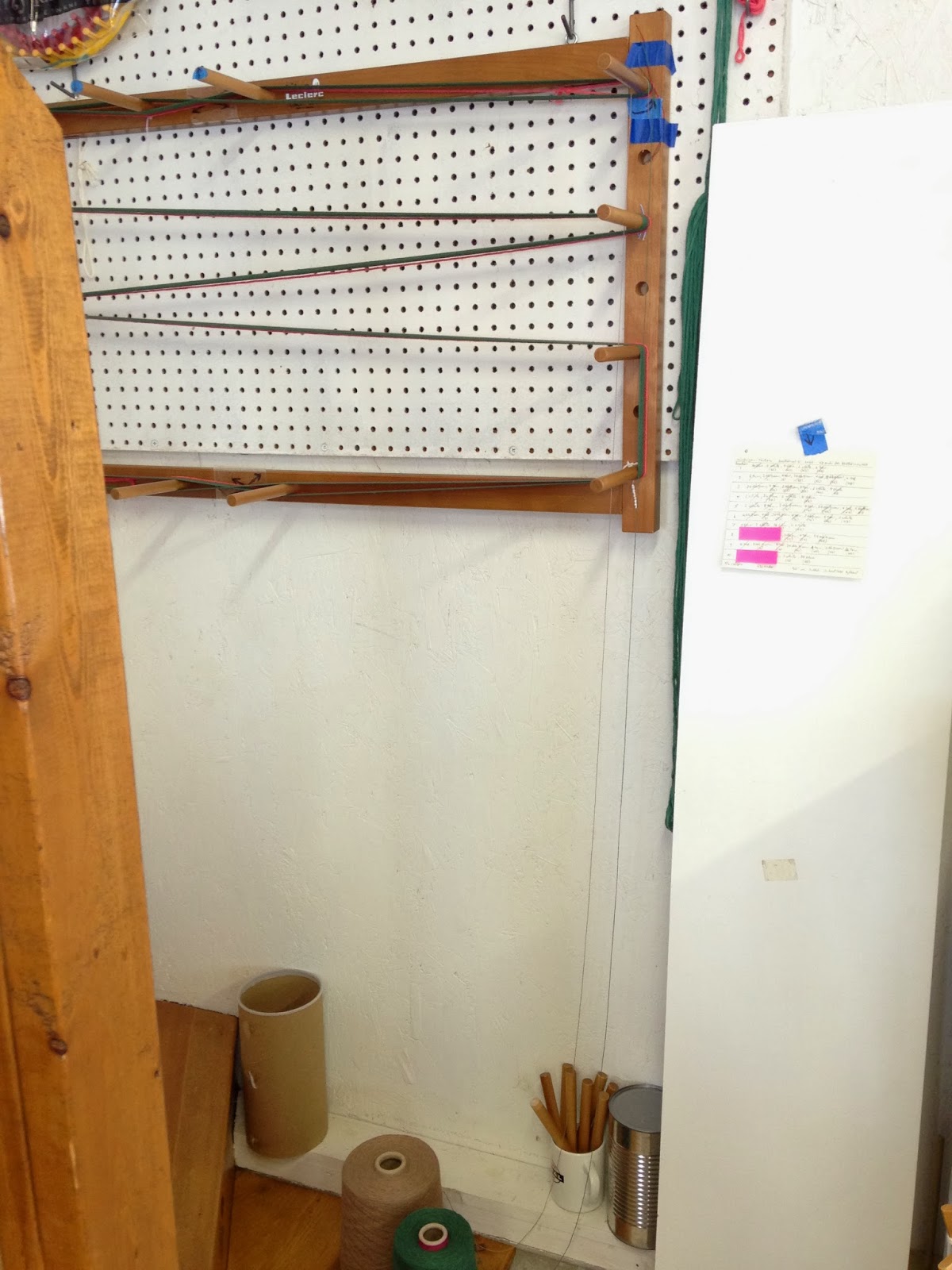
I only had one cone of each color, so I wound the colors on my warping board, one section at a time.
As I finished each section, I took it off the board and threaded it through my tension box and wound it onto the warp beam.
I use eight pieces of plastic tubing seen on the pegs to keep the yarn from accidentally going into the sections on either side.
Frequent color changes can be aggravating without a plan. I figured out quite a while ago that it was a waste of time to tie the color changes together at the first peg. Now I put tape on the board and tape the beginning of each color below the peg and the end gets taped above the peg. It makes warping much faster.
Each section end of the warp gets taped before removing from the tension box so the threads will be in order for threading. Here are eight of the ten sections prepared.
Before threading each section, the warp is taped to the shuttle race at the front of the loom in a handy spot for picking the next thread.
I threaded the 12 dent reed with two warp ends per space. When I was done, I knew I was right about needing to wind 26-28 ends per section, because the warp in the ten sections was wider than in the reed. It wasn't bad enough to do over, and besides, this was all just an experiment, with the spacing included. Next time I will add more warp ends per section.
I got everything tied onto the apron rod and wove a small amount to spread the warp. Note that the lacing from the apron to the rod does not extend much past the width of the towel. If it was laced to the ends of the rod, the towel would pull on the center and bow the rod. Keep the lacing the same width as the weaving to avoid tension problems once weaving begins.
The first towel was just one weft color as I worked on adjusting the loom. I had a lot of broken warp threads as I tried to adjust everything. The shuttle kept going crooked through the shed from the right side.
I eventually ended up putting a different picker heel on that wasn't as worn as the one I started with. It did help a lot. All the warp breakage occurred on the first towel and the first inch of the second towel. I got a lot of practice repairing warp threads on this big old loom!
Tuesday, March 4, 2014
Replacing the Paper on Weaving Reeds
I came across a reed today that I had replaced the paper coverings on the edges with masking tape. I knew when I did the repair that it probably wouldn't last long, since masking tape tends to get brittle pretty quickly.
The tape was not sticking, so I decided to try gluing it back down with Tacky Glue. It sort of worked, but not entirely to my satisfaction because it rippled a bit and I had to keep pushing on it to make it stay.
I started looking for something else that was thin to try instead and decided to try parchment paper, the type used for covering baking sheets. It is found in the grocery near the wax paper and foil.
I cut a small test piece, enough to wrap around from front to back, put some glue on the paper, folded it together to smear the glue around and then wrapped it around the edge of the reed. It stuck with no trouble, created a few wrinkles which I was able to remove and then I left it to dry.
I checked it a few minutes ago and it is firmly glued to the reed edge with no indication that it is going to peel off the reed.
This is definitely the way to go to replace old flaking paper covers. It is inexpensive, thin, easy to cut with a rotary cutter and ruler, will actually stick, and looks like the repair should last for a long time.
An added bonus is the remainder of the parchment paper can be used in the kitchen. I love using it because I dislike trying to get baked-on grease off my cookie sheets. I never have to do that when I use the paper.
The tape was not sticking, so I decided to try gluing it back down with Tacky Glue. It sort of worked, but not entirely to my satisfaction because it rippled a bit and I had to keep pushing on it to make it stay.
I started looking for something else that was thin to try instead and decided to try parchment paper, the type used for covering baking sheets. It is found in the grocery near the wax paper and foil.
I cut a small test piece, enough to wrap around from front to back, put some glue on the paper, folded it together to smear the glue around and then wrapped it around the edge of the reed. It stuck with no trouble, created a few wrinkles which I was able to remove and then I left it to dry.
I checked it a few minutes ago and it is firmly glued to the reed edge with no indication that it is going to peel off the reed.
This is definitely the way to go to replace old flaking paper covers. It is inexpensive, thin, easy to cut with a rotary cutter and ruler, will actually stick, and looks like the repair should last for a long time.
An added bonus is the remainder of the parchment paper can be used in the kitchen. I love using it because I dislike trying to get baked-on grease off my cookie sheets. I never have to do that when I use the paper.
Thursday, February 13, 2014
Experimenting With the Weaver's Delight Wooden Yarn Shuttle
Last spring, while visiting Ole' Lou and his wife Betty down in Arkansas, I shamelessly begged an old wooden shuttle off him. I thought I had seen it during another visit and was pretty sure he didn't use it. I didn't know of anyone else with a Weaver's Delight loom that had one, and also never talked to anyone who had woven fabric on their rug loom.
I brought it home along with a few pirns for winding on yarn for the shuttle. This is a big shuttle, about the same size as the cast aluminum ones for the rags. It measures about 16" long and is 3-4" high.
It has a patent number stamped on the top. Last fall, my dad took a look at it and did some repairs. One of the pointed cones came out and needed gluing again. We got that repaired and Dad turned a couple more pirns, using the old ones for a guide. I brought it all home and put it away until recently. Other things like cancer treatments got in the way of my doing anything with it. I got it out last week and decided to clean it up and try using it.
I sanded all the wood and found out most of the dark color was just dirt. After a coat of stain, I put a couple coats of polyurethane on everything.
The wire fits in two holes inside the shuttle and loops around the pirn in the groove. Pushing on the flat end of the pirn bows the wire enough to give some tension to the pirn and holds it in place when seated in the shuttle.
I had my dad make the new pirns about 2" longer than the original ones. I wasn't sure if there was a reason for the original ones to be shorter, so I thought I could start out with them a little longer and cut them off if they didn't work.
There was a reason for them being shorter! The longer one worked fine until there was just about 1" to1 1/2" of yarn left on the pirn and then it started to get caught on the tip. It caused some broken warp threads from being tugged off the shuttle race.
Well, isn't that what experimenting is all about? I know how to fix broken warp threads and will show some photos of the process in another blog post.
Here is the shuttle all loaded with yarn and threaded and ready to go. The thread is exiting under a spring steel tension clip. I am thinking bout replacing it with something else that may let me change the tension a bit and have a little more control of the yarn pulling at the selvedges. (Or not pulling!)
Stay tuned for winding a tartan warp to put on the WD sectional beam and repairing broken warp threads.
I brought it home along with a few pirns for winding on yarn for the shuttle. This is a big shuttle, about the same size as the cast aluminum ones for the rags. It measures about 16" long and is 3-4" high.
It has a patent number stamped on the top. Last fall, my dad took a look at it and did some repairs. One of the pointed cones came out and needed gluing again. We got that repaired and Dad turned a couple more pirns, using the old ones for a guide. I brought it all home and put it away until recently. Other things like cancer treatments got in the way of my doing anything with it. I got it out last week and decided to clean it up and try using it.
I sanded all the wood and found out most of the dark color was just dirt. After a coat of stain, I put a couple coats of polyurethane on everything.
The wire fits in two holes inside the shuttle and loops around the pirn in the groove. Pushing on the flat end of the pirn bows the wire enough to give some tension to the pirn and holds it in place when seated in the shuttle.
I had my dad make the new pirns about 2" longer than the original ones. I wasn't sure if there was a reason for the original ones to be shorter, so I thought I could start out with them a little longer and cut them off if they didn't work.
There was a reason for them being shorter! The longer one worked fine until there was just about 1" to1 1/2" of yarn left on the pirn and then it started to get caught on the tip. It caused some broken warp threads from being tugged off the shuttle race.
Well, isn't that what experimenting is all about? I know how to fix broken warp threads and will show some photos of the process in another blog post.
Here is the shuttle all loaded with yarn and threaded and ready to go. The thread is exiting under a spring steel tension clip. I am thinking bout replacing it with something else that may let me change the tension a bit and have a little more control of the yarn pulling at the selvedges. (Or not pulling!)
Stay tuned for winding a tartan warp to put on the WD sectional beam and repairing broken warp threads.
Wednesday, February 12, 2014
Another Type of Homemade Weaving Temple
This is part of my experiment with weaving fabric with my Weaver's Delight automated fly-shuttle loom.
My regular temple that came with my Weaver's Delight rug loom is too wide for what I needed. I needed something to spread the warp to the width in the reed, so I devised a floating temple, unlike the paperclip temples I use on my other looms.
With the flyshuttle, I was unable to run a cord from the front beam to the back beam to drape the weight cords over, like on the other looms.
This is what is working for me. I saw something similar quite a while ago and looked around for something I could use to try it.
I used a yardstick, two clamps, two paperclips and some linen rug warp. I had my husband cut the yardstick a little shorter and narrower and drill a hole in each end.
I attached the rug warp to the end of each clip and another couple pieces to each end of the stick. I attached the paperclips to the cords with enough tension to bow the stick when the clamps were attached to the fabric. Alligator clips could also work, but I just used what I had in the studio.
So far it has worked pretty well. It does ride on the shuttle race when I beat but is not on the race when the shuttle flies across.
If I need more tension to the temple, I can reattach the clips so the stick bows a bit more.
The fabric on the loom is the start of a towel I am weaving with the Michigan Tartan colors.
My regular temple that came with my Weaver's Delight rug loom is too wide for what I needed. I needed something to spread the warp to the width in the reed, so I devised a floating temple, unlike the paperclip temples I use on my other looms.
With the flyshuttle, I was unable to run a cord from the front beam to the back beam to drape the weight cords over, like on the other looms.
This is what is working for me. I saw something similar quite a while ago and looked around for something I could use to try it.
I used a yardstick, two clamps, two paperclips and some linen rug warp. I had my husband cut the yardstick a little shorter and narrower and drill a hole in each end.
So far it has worked pretty well. It does ride on the shuttle race when I beat but is not on the race when the shuttle flies across.
If I need more tension to the temple, I can reattach the clips so the stick bows a bit more.
The fabric on the loom is the start of a towel I am weaving with the Michigan Tartan colors.
Wednesday, February 5, 2014
Prayer Shawls, Blankets and Lap Quilts
When I found out I had cancer, another friend sent me a prayer blanket (the lavendar one with the cross). Both the blanket and shawl went with me to the hospital when I had my surgery. I must have said something to Dr. Michelin about the shawl, because when he came to check on me after my surgery, I had it on and he asked if it was my "prayer sweater". I thought that was kind of funny, but he remembered it and what it was about.
While undergoing my chemo treatments, my church presented me with a prayer lap quilt, signed by the church members (the quilt is on the back of the chair). I don't know how I could be so blessed so many times. The quilt goes with me every time I go for chemo because I get cold sitting so long in a cool room. It is just the right size for covering my legs. I was given two other gifts of love, the heart quilt and the lovely red and grey wool shawl by two other good friends. They are all loved and I will cherish them. As you can see, our kitty, Schwarz, thinks they are pretty special too.
Since all those blessings have come my way, I wanted others to experience God's love and prayers. The shawls I have been working on are woven on one of my looms. It is a restful, relaxing time when I get to talk to God and hopefully impact someone else that needs to feel God's arms around her or him.
This is the first shawl I made. I love how the stripes turned out with the variegated yarn.
This is the type of yarn I have been using. It is a giant skein from Joann Fabrics. I chose it because of it's easy care properties. It can be washed in the washer and dried in the drier. The loom was warped at 16 ends per inch in a 12 dent reed with a width of 18" - 20" for a shawl. I use 8/2 size yarn for the warp. The warp is about three yards long, and I wove shawls a bit over two yards long. The fringe is twisted and knotted at the ends.
I had a friend try using the boucle yarn for the warp and she couldn't get a shed open to weave. The cotton warp is best, since it isn't sticky. I beat gently while weaving and it made a nice warm but lightweight shawl.
This skein is for my third shawl.
This is the start of my second shawl. It is a variegated yarn with just three colors. I didn't know who it was going to be for so I prayed generic prayers for the recipient. As I wove more, I kept thinking of my neighbor. She had taken such good care of me and Bob while I was getting chemo and now she was having some difficulties. I started praying more for her and decided this shawl was hers.
I wanted this shawl to reverse colors so the ends would mirror each other. I kept track of the colors and length on the paper tape to the left. When I got to about the center of the shawl, I had to wind the yarn on my swift first so I could get the right colors on my shuttle in the reverse order. The tape helped me do that.
The tape is on top of a wonderful sheepskin my son Edwin and his wife Rebecca gave me for Christmas this year. How nice it is to sit upon, with it draped over the rocking top weaving bench Bob made me a while ago. Since getting both gifts, I have had no problems with pressure to the backs of my legs while weaving.
I was able to give the second shawl to my neighbor at our Bible study a couple weeks ago. She had the same experience I did when she put it on. It is such a good reminder that God is there when we need him.
I would like to encourage anyone with needlework skills to take on a shawl, blanket, or quilt project. Knitting, crochet, weaving or quilting can be a meditative occupation. Think of the blessings that can come from your hands.
May God bless you in your endeavors.
Wednesday, January 22, 2014
Loom Held Hostage
A loom is too expensive of a tool to be held hostage. Almost three years ago, in March of 2011, I put this wool warp on my Artisat loom. It was a slow moving project right from the start because it required four shuttles to weave. I would work on it a little bit and grow tired of all the shuttle switching and move on to another project on another loom. It didn't help that the colors don't really appeal to me either, so I didn't have much motivation to get it done, other than to free the loom for something more interesting.
Late last year, I decided I was going to either finish it or cut it off the loom. I did end up cutting the New Canaan Check fabric off after using up my filled bobbins. I did some easier weaving with the tan, wine, rust and plum rayon textured yarns I was using.
I figured I still had 2-3 yards of warp on the loom so I chose a dark blue green color wool to weave plain weave.
I finally finished weaving it after Christmas. I wove a little bit more with the rayon and called it good. Wet finishing was done and I ended up with less fabric than I thought I would have. I was going to give it to my daughter Becky to make a tunic, but there might not be enough. Maybe I will make another bear or a hat with it.
Wet finishing created a pattern in two of the stripes that is called tracking. The white yarn didn't track because it was slightly thicker than the other two stripes. The tracking has something to do with the twist of the yarn and having a little bit of wiggle room in the weave. I kind of like the look of it.
It's good to have my loom back and working again. I will post later about the project on it now.
Tuesday, December 31, 2013
Annual Christmas Towels
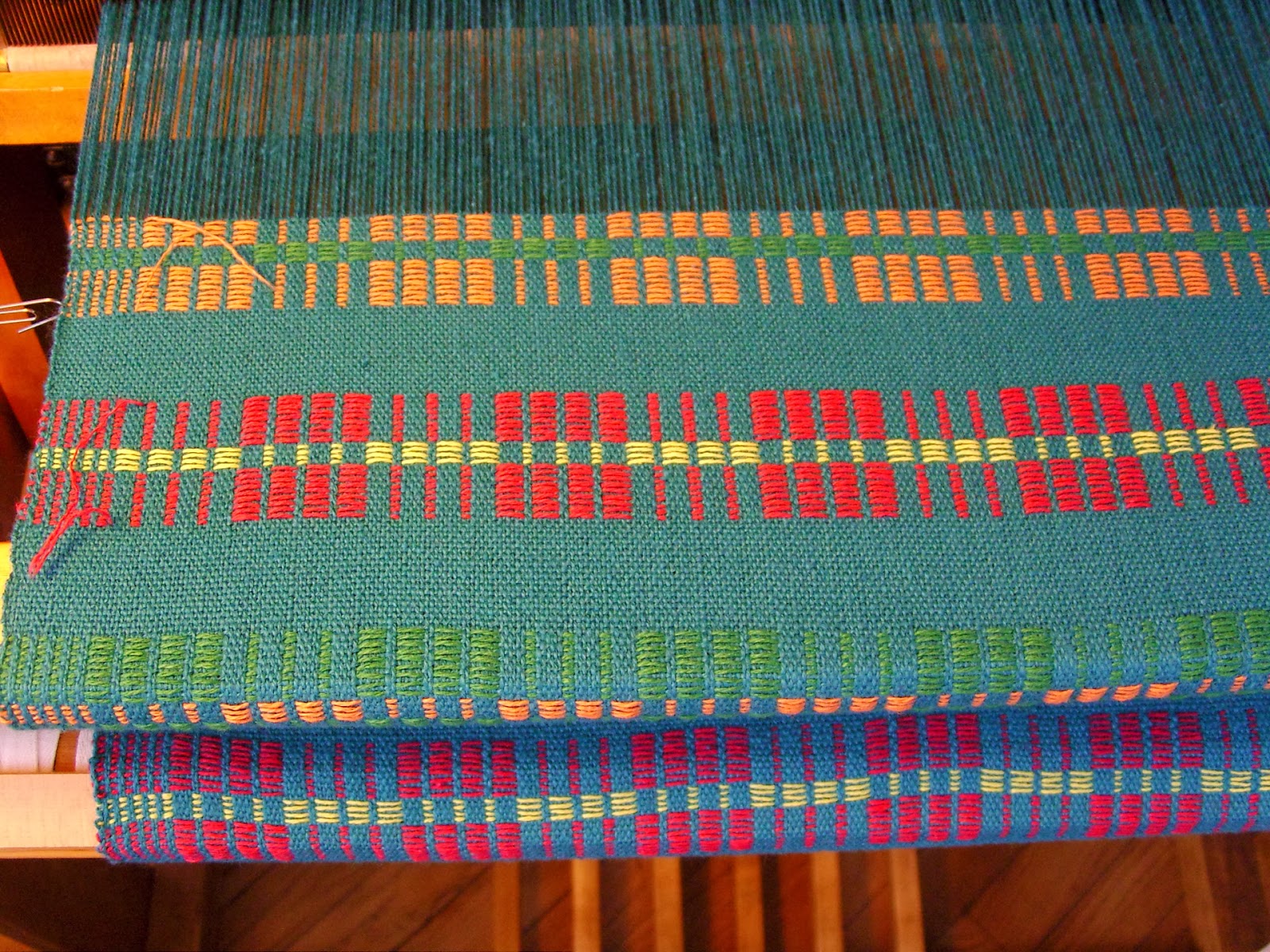
This year, I got an early start when I came home from vacation in April with a big cone of 8/2 cotton yarn in a teal color. I decided on a monk's belt pattern from Handwoven Design Collection #18. I wound the warp for six towels and started the threading in June. It was a good thing I got an early start, because I was diagnosed with ovarian cancer early in July and had major surgery a week later. While recovering from surgery, I sat for many days looking at the loom that was partially threaded. As I started feeling a bit better and became bored doing nothing, I decided to see if I could finish the threading.
Working a few minutes at a time, I got it ready for the first towel. Now, all I needed were yarn color choices from the girls. Three of them were here a week later to check up on me and to come for the Charlevoix Venetian Festival. They picked their colors and I was able to start.
Carolyn's towel was first. The colors she chose were light orange, red, green and yellow. The yarns used were 8/2 cotton.
After weaving this one with a single strand of yarn for the pattern, I decided the rest of the towels needed the pattern yarn to be doubled. Also, the green she chose didn't show very well because it was too close in color value to the teal warp.
Rachel said she wanted her towel to be mostly white pattern, but I made her pick two other colors to add a little interest and to give me something to work with in developing the pattern. She chose light orange and yellow. It was my plan for each towel to be completely different from each other, even though they were woven on the same warp and all threaded the same. I think this one came out very nice. The colored yarns are all 8/2 cotton. The white is 50/50 cottolin in a similar size to the cotton, something like 22/2. It is too cold to go outside to the studio to look.
My DIL Jenn's towel is the orange and lime green towel on the left. I tried to tone down the teal by weaving the tabby with brown and olive green 8/2 cotton. The orange and lime green are both cottolin.
These towels were all pretty slow going, since it took me a long time to recover from my surgery. As I started my chemotherapy treatments, they gave me something to focus on besides being sick. They were quite good therapy.
This towel is for my DIL Rebecca. She wasn't here to pick her colors, but she loves anything blue, so my daughters and I picked for her. I used
navy, wine, ocean green and light blue.
As I was working on this towel I managed to break my hand doing something I shouldn't have been doing. My doctor splinted it, but I could tell a few days later that it wasn't going to heal that way because every morning when I woke up, the splint was out of position and the bone was bent at the break.
I had our hand specialist at work look at it after the weekend and he set it and put in into a cast. It was much more comfortable after getting the cast but I still wasn't supposed to use it, so weaving was put on hold for a few weeks.
I was then put in a removable splint since it was starting to heal. I was happy because my doctor was worried that the chemo would slow the healing. It didn't, and I was able to start weaving again.
I was able to finish Rebecca's towel and get started on the last one needed for Christmas. This towel was for my daughter Becky. She chose off white, navy, red, light orange and light green. The eleven treatments I was getting for the cancer was taking a toll on me though, so I couldn't weave for very long at any one time. I was getting a bit worried that I wouldn't finish it in time. I had a good week when I had a week off from chemo and was able to finish it.
It is always nice to have a little warp left over to make something for myself. My favorite color is red, so I dug through my box of yarns that I had dyed and found quite a range of pinks to reds to purples and came up with this towel. It is my favorite.
Group photo. I was very happy to finish all of them before Christmas.
An incidental note about this warp. When September rolled around, I heard from a friend who also has ovarian cancer that September was ovarian cancer awareness month and their color was teal.
I am not much of one for following all the color fads for all the different "awareness" months or weeks, but I guess it does give me an opportunity to inform women that there is no screening test for ovarian cancer, and because symptoms can be kind of vague and attributed to other things, most ovarian cancers are not caught until later stages.
Here is a list of symptoms, with the first four being the most common:
1. Abdominal or pelvic pain.
2. Increased abdominal size or persistent abdominal bloating.
3. Needing to urinate often or urgently.
4. Feeling full after eating a small amount.
5. Changes in bowel habits.
6. Bleeding after menopause or in between periods.
7. Unexplained weight gain or loss.
8. Lower back pain.
9. Indigestion or nausea.
10. Excessive fatigue.
11. Pain during sex or bleeding after sex.
Out of the eleven symptoms, I had eight of them. If any of these symptoms are new to you and you experience them frequently over a 2-4 week period, talk to your doctor and besides checking for other causes, ask him or her about the possibility of ovarian cancer. My stage 3c cancer was found with a CT scan. I was referred immediately to a gynecologic oncologist and was in surgery the next week.
I wish I had known this information months before I was diagnosed. Hopefully this list will help someone else to seek treatment in an early stage. Having the symptoms doesn't necessarily mean you have cancer, but checking the symptoms with your doctor could possibly save your life if it is and is caught early.
Now, I am looking forward to a better new year in 2014.
Monday, December 2, 2013
Five More Rugs Finished on Leclerc Fanny
I love finishing a warp.
This warp was a little long for me. I start to get bored with the same colors, so I was happy to have this one finished, but I love every one of the rugs. They are all resting on the floor for a couple days before hemming since rugs change shape after being taken off the loom. After being stretched so tight on the loom, it takes a couple days for them to shrink down to their final size.
It is always a challenge to see what I can come up with from my fabric stash. I make such a mess in the studio as I try and mix and match fabrics, making sure I will have enough strips to make a whole rug. There is nothing worse than getting almost done and running out of a unique fabric before the rug is long enough.
I thought that happened with the turquoise rug, but finally found the basket with the remaining strips.
The warp made six rugs. This was the first one, finished a while ago. It used up a collection of polyester double knit from my stash. The light color was from a bolt of very ugly gray, tan and white striped fabric. The navy and red was from my mom's stash collected years ago when women actually wore clothing from this horrible material.
When the warp wears out, the fabric strips will still be as good as new.
More polyester double knit from the same collection of my mom's. These are all quarter-inch checked fabric. Click on the photo to make it bigger.
This one was fun. I liked how the x's turned out on the white stripes.
This one also gets the x's. The fabric came from the bargain table at Wal-mart. It has my granddaughter Trisha's name on it since she loves anything blue.
Blues were starting to get monotonous so I changed this one and added pink and tan. I think it is one of the prettiest ones from this group.
I am not a big fan of looper rugs but they are fast to weave. I had a bag of fat loopers (like potholders are woven from) given to me by my friend Lou down in Arkansas. I still haven't perfected getting nice edges and hems. I may end up binding the ends instead of turning a hem since they are pulled in so much. I will decide in a couple days when I start hemming all of them.
This is the draft I used, obviously repeating to add more stripes and reversing the threading for the opposite edge. A floating selvedge would be helpful for this weave.
I will get this posted and then need to get to bed. I have chemo again tomorrow morning and have to leave the house before 7 am. I am so looking forward to being done. Two more to go--tomorrow and one more next week. Night all.
This warp was a little long for me. I start to get bored with the same colors, so I was happy to have this one finished, but I love every one of the rugs. They are all resting on the floor for a couple days before hemming since rugs change shape after being taken off the loom. After being stretched so tight on the loom, it takes a couple days for them to shrink down to their final size.
It is always a challenge to see what I can come up with from my fabric stash. I make such a mess in the studio as I try and mix and match fabrics, making sure I will have enough strips to make a whole rug. There is nothing worse than getting almost done and running out of a unique fabric before the rug is long enough.
I thought that happened with the turquoise rug, but finally found the basket with the remaining strips.
The warp made six rugs. This was the first one, finished a while ago. It used up a collection of polyester double knit from my stash. The light color was from a bolt of very ugly gray, tan and white striped fabric. The navy and red was from my mom's stash collected years ago when women actually wore clothing from this horrible material.
When the warp wears out, the fabric strips will still be as good as new.
More polyester double knit from the same collection of my mom's. These are all quarter-inch checked fabric. Click on the photo to make it bigger.
This one was fun. I liked how the x's turned out on the white stripes.
This one also gets the x's. The fabric came from the bargain table at Wal-mart. It has my granddaughter Trisha's name on it since she loves anything blue.
Blues were starting to get monotonous so I changed this one and added pink and tan. I think it is one of the prettiest ones from this group.
I am not a big fan of looper rugs but they are fast to weave. I had a bag of fat loopers (like potholders are woven from) given to me by my friend Lou down in Arkansas. I still haven't perfected getting nice edges and hems. I may end up binding the ends instead of turning a hem since they are pulled in so much. I will decide in a couple days when I start hemming all of them.
This is the draft I used, obviously repeating to add more stripes and reversing the threading for the opposite edge. A floating selvedge would be helpful for this weave.
I will get this posted and then need to get to bed. I have chemo again tomorrow morning and have to leave the house before 7 am. I am so looking forward to being done. Two more to go--tomorrow and one more next week. Night all.
Subscribe to:
Posts (Atom)