A few sewing techniques that aren't common knowledge can make a difference in how hems on towels turn out. After taking so much time designing a beautiful towel, the goal is to have a hem that is equally attractive.
The techniques I use avoid some common complaints such as flared hems, rippling hems, and weft threads unraveling or poking out from the ends of the hems.
The first thing I do is serge apart my group of towels before wet finishing, leaving a thread tail of about 1 1/2" - 2" at each end. Serger chains tend to unravel, so an overhand knot on the chain somewhere will allow the chain to stay intact during wet finishing. Many of the machine stitches on a sewing machine will work also if a serger isn't available, but the ends should be very secure so the weft doesn't unravel.
Wet finish using standard instructions for your yarn type. Dry and steam press.
I turn the hem while doing my heavy steam pressing. Don't let the hem area flare out. The best time to control flaring is with pressing during wet finishing. That is the press that will set the threads into memory. If they are allowed to flare at this point, it is almost impossible to correct it later.
Pull the tail onto the first hem crease, pulling a tiny corner of the towel into the hem.
Fold up the next fold, enclosing the tail and corner. There shouldn't be anything sticking out. Pin if necessary to keep control. The top and bottom layer should be aligned.
Pick a thread color that is the least conspicuous when placed across the cloth and thread the sewing machine.
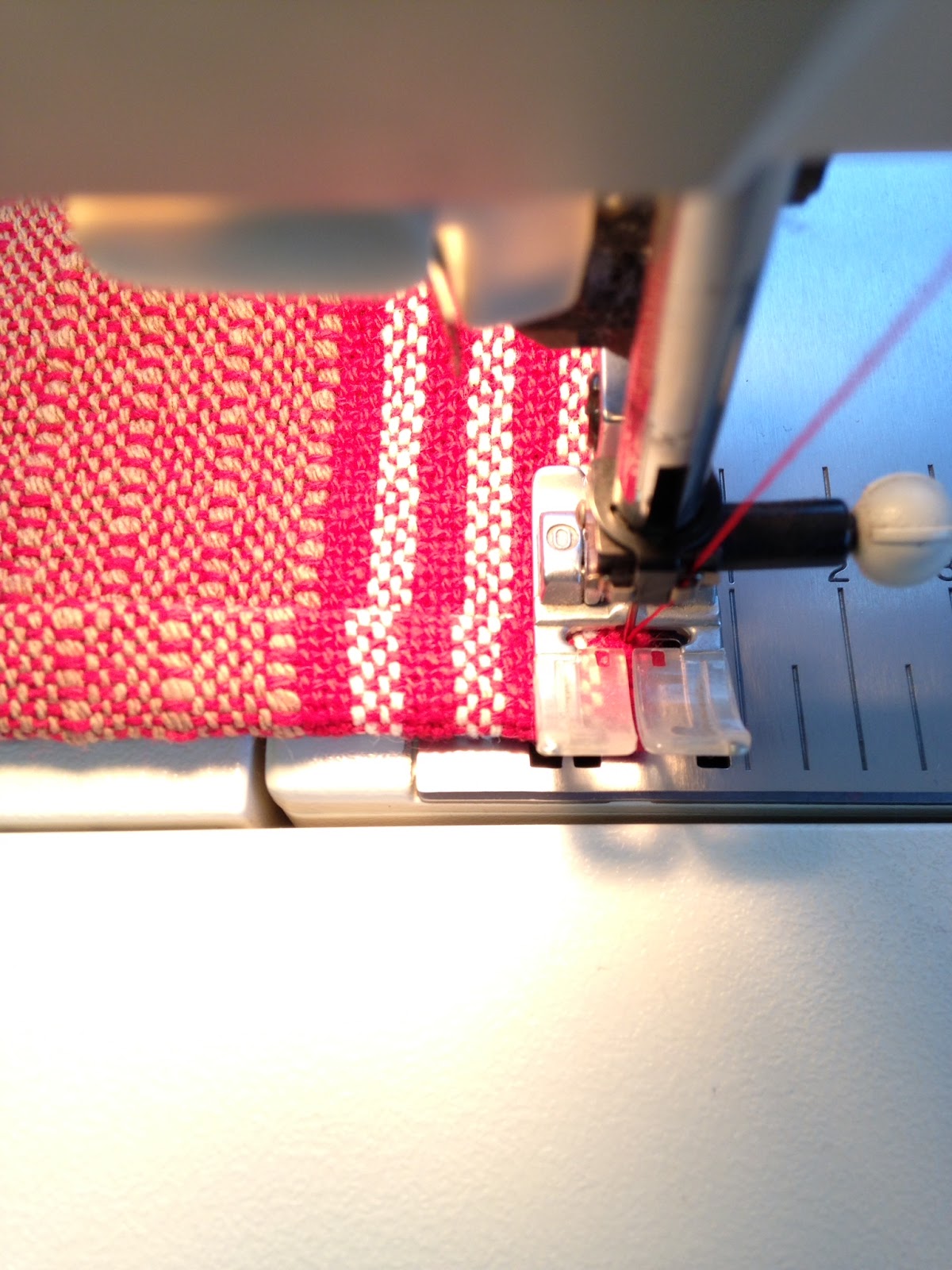
Starting at the top corner, one warp thread in from the hem edge, put the needle down through the layers and check the alignment again at the edge.
Do not sew over pins, unless you like to fix snagged warp or weft threads, purchase new needles or to pay for your machine to be timed again.
Stitch to the corner and reverse back to the start point, leaving the needle in the down position. Raise the foot and pivot to start sewing across the hem.
If you look carefully at the photo, you can see a little ripple of fabric in front of my finger. (Clicking on the photo should enlarge it.) This is an easing technique used in the sewing industry. The little ripple is pushed toward the foot as the hem is sewn. It actually eases a tiny amount more fabric under the foot than the feed dogs are pulling and keeps the hem from flaring. Don't ever pull on the hem while sewing.
If you don't have a lot of control of your machine speed, you may want to use something other than your finger to do the pushing. Pierced fingertips will leave blood on your pretty towel!
Remove pins before you get to them, keeping stripes or pattern aligned until the other end of the hem is reached.
As you get close to the end, the beginning process will be repeated. If you didn't turn in the other chain and tiny corner when turning up the hem, do so now.
When you reach the end, put the needle down one thread from the edge, pivot, align the edge and sew to the bottom corner, and reverse to the top of the hem.
Showing posts with label hemming towels. Show all posts
Friday, May 5, 2017
Thursday, March 20, 2014
Should Towels Be Hemmed Before or After Washing?
Regarding wet-finishing handwoven towels before or after hemming, here is my rationale for doing hemming after washing.
I always wet-finish before touching my fabric with an iron for the following reasons. Wet finishing removes the spinning oils, allows shrinkage to take place and also fills in the spaces between the threads when the yarn softens with the washing.
It allows the threads to move, especially with lace and waffle type weaves and with any weaves that were irregularly sett in the reed, the threads will move to fill in the spaces making the reed lines disappear. Shrinkage quite often occurs during the wet-finishing process. If hems are done before washing, they become puckered when the fabric shrinks. I would want all of the above to take place before doing my hems.
Even with washing first, some reed lines may still be faintly visible, as the center towel shows.
Part of the wet finishing process is finishing your cloth with a hard press and that is not the same thing as ironing. Ironing is gliding the iron over the surface of the cloth. Hard pressing is exactly that--pressing hard for several seconds without gliding the iron.
I hard-press my partially dry towels either with my steam press or I cold mangle them straight from the washer on my counter with my marble rolling pin. I always cold mangle linen because drying it in the dryer can take away the beautiful sheen and make the threads appear dull.
What the hard press or cold mangling does is set the threads in the fabric, creating a memory for those threads. It makes it a little bit harder for the fabric to unravel and move in the weave. By pressing a hem in first before wet finishing, irregularities such as reed marks that are there before wet finishing will be made permanent. Those irregularities become the memory of the fabric and more than likely will not wash out with wet finishing later.
I sometimes wash all the towels I've made without separating them, but more than likely I will separate them with the serger because I have used colors that I wouldn't want to bleed onto another towel. I try to use dye fast yarns, but occasionally one isn't as fast as was claimed by the seller. I hate those kinds of surprises!
This is an example of before and after washing. Notice how the purple bled, changing the white yarn into a lighter purple. If I had not cut the three towels apart and washed them separately, the small sample at the end would have ruined the two other towels.
Another reason to separate a long row of towels is that they can get twisted in the washer and dryer and that will often permanently set wrinkles into the fabric.
I always wet-finish before touching my fabric with an iron for the following reasons. Wet finishing removes the spinning oils, allows shrinkage to take place and also fills in the spaces between the threads when the yarn softens with the washing.
It allows the threads to move, especially with lace and waffle type weaves and with any weaves that were irregularly sett in the reed, the threads will move to fill in the spaces making the reed lines disappear. Shrinkage quite often occurs during the wet-finishing process. If hems are done before washing, they become puckered when the fabric shrinks. I would want all of the above to take place before doing my hems.
Even with washing first, some reed lines may still be faintly visible, as the center towel shows.
Part of the wet finishing process is finishing your cloth with a hard press and that is not the same thing as ironing. Ironing is gliding the iron over the surface of the cloth. Hard pressing is exactly that--pressing hard for several seconds without gliding the iron.
I hard-press my partially dry towels either with my steam press or I cold mangle them straight from the washer on my counter with my marble rolling pin. I always cold mangle linen because drying it in the dryer can take away the beautiful sheen and make the threads appear dull.
What the hard press or cold mangling does is set the threads in the fabric, creating a memory for those threads. It makes it a little bit harder for the fabric to unravel and move in the weave. By pressing a hem in first before wet finishing, irregularities such as reed marks that are there before wet finishing will be made permanent. Those irregularities become the memory of the fabric and more than likely will not wash out with wet finishing later.
I sometimes wash all the towels I've made without separating them, but more than likely I will separate them with the serger because I have used colors that I wouldn't want to bleed onto another towel. I try to use dye fast yarns, but occasionally one isn't as fast as was claimed by the seller. I hate those kinds of surprises!
This is an example of before and after washing. Notice how the purple bled, changing the white yarn into a lighter purple. If I had not cut the three towels apart and washed them separately, the small sample at the end would have ruined the two other towels.
Another reason to separate a long row of towels is that they can get twisted in the washer and dryer and that will often permanently set wrinkles into the fabric.
Subscribe to:
Posts (Atom)