Showing posts with label Swedish counterbalance loom. Show all posts

Tuesday, February 12, 2019

Securing Texsolv Heddles on Open Ended Shaft Bars

 A few days ago, I read about a good way to secure Texsolv heddles on the open shaft bars on my Swedish type counterbalance and countermarche looms.

The shafts are two separate wooden bars with holes in each end to thread a string from end to end. The reason for the string is to maintain the order of the heddles if any were to accidently fall off the bar.

After adding or subtracting heddles, I would sometimes not tie the security strings back through the holes, mostly due to laziness but I blame it on my arthritis in my fingers.

I have no excuse now with this method. It involves using elastic bands instead of string.

I used a roll of elastic I had in my stash from doll clothes making days.  It is about 1/8" wide. I cut two lengths approximately the length of a shaft bar.

I tied a loop at one end of one elastic and kept the other as a guide to cut the rest of the bands.
I put the first one on and adjusted the length so it had to stretch slightly and tied another loop at the other end. I needed to trim a little off the band to make it fit, so I trimmed the same amount off the second elastic.
I marked both ends of my guide so I would be consistent in cutting the other eighteen pieces.
 After tying loops on each end of all the remaining elastics, I started putting them on my shafts.

An easy way to thread the elastic through the end holes is to use a bobby pin.
Thread the loop through the end hole.
Wrap the loop around the end of the shaft bar and remove the bobby pin.
With the other bobby pin at the other end, thread it under the strings holding the shafts.

The elastic needs to be against the
heddle loops, so don't go over the
jack cords.

Thread the loop through the hole at the other end and stretch it around the end of the shaft bar.

I keep a few bobby pins in my tool box, for threading the loops if I ever need to change my heddle numbers.

There is no excuse now to not secure the heddles, since I don't have to untie knots any more. The elastic slips on and off with ease.


Wednesday, December 27, 2017

Tying a New Warp to an Old One, Lashing On, and Handling Pesky Color Changes


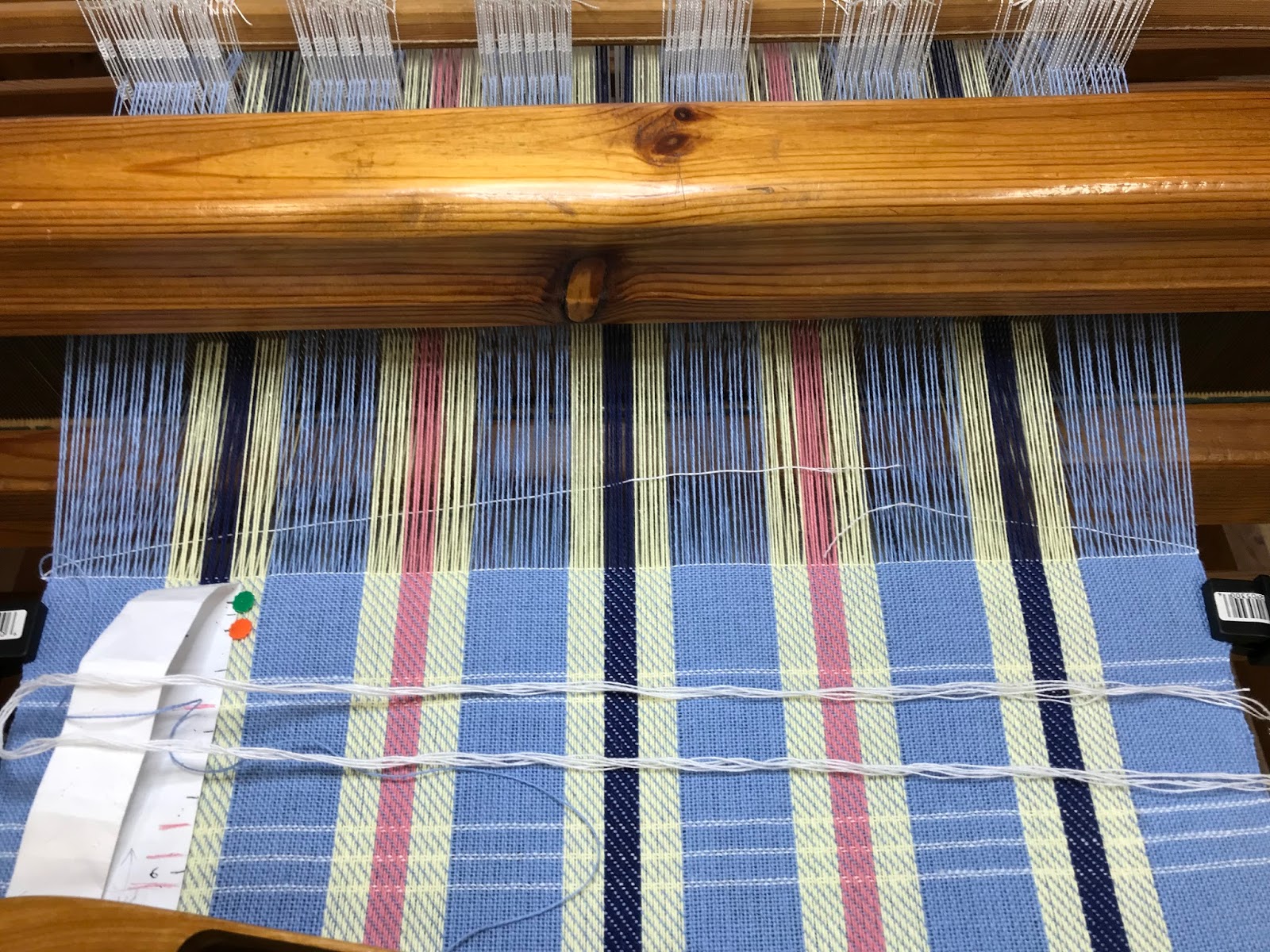
I recently finished three dish towels on Julie, my Swedish counterbalance loom. The design was a six shaft, combination of plain weave and 3/1 twill stripes.  I liked how they turned out, the weaving went quickly, and it was a single shuttle weave for the most part. I decided to wind another warp in different colors and rather than thread the six shafts all over again, to tie them to the old warp.

I wound each stripe of 30 or 40 threads separately, tying the cross on each bout, and placing a tight choke tie about 12" - 18" from the cross. I threaded them onto lease sticks at the front of the loom.
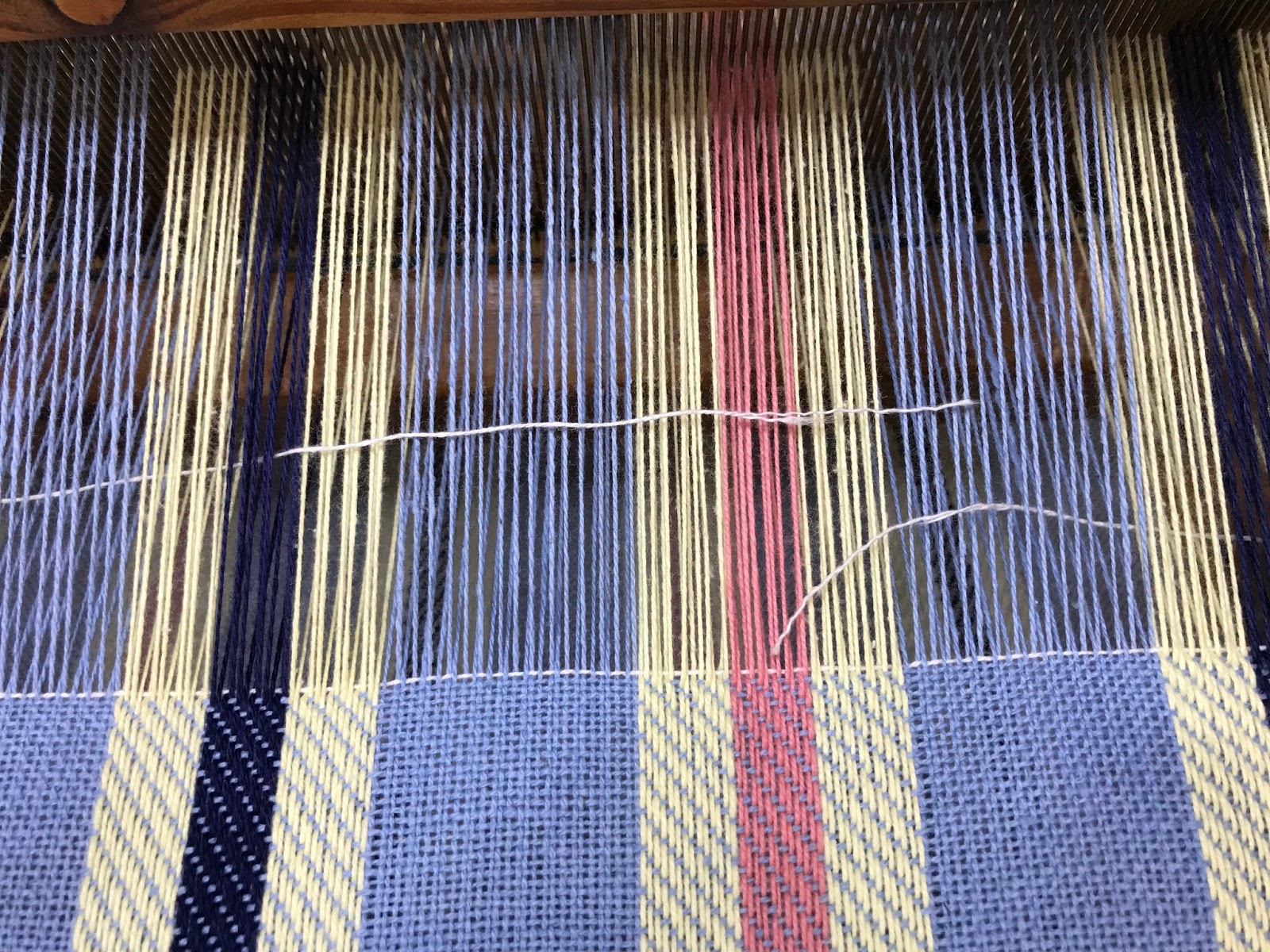
I left the previous towels on the loom and attached my tarp clamp temple to the edges to support them when I started to snip threads.  I clipped and tied one thread at a time and tied with an overhand knot.

I don't think I saved any time, but it was easier on my eyes, neck and shoulders than threading six shafts of texsolv heddles. Everything was right in front of me. The knots slipped through the reed and heddle eyes with only a little gentle coaxing.

These are the two towels after taking them off the loom and wet finishing them. I wove them each with a different color red.
I used the lashing on method after winding on my second warp.  I am becoming a fan of this method, which I learned from Milissa Ellison Dewey in one of her Facebook weaving group  posts. It is fast, easy, and gives a nice even tension to the warp. I wish I had a link to post here, but can't find anything.
Below the dark blue line is the finish of the first towel in these colors. It was woven in a light gray.

I like the look of cross stripes, but can add a fair amount of extra time to my weaving and usually requiring a second shuttle.

I am not a proponent of calling errors a "design element", but I did make an error that I decided I could incorporate into the design. I intended on using a double white line evenly spaced, but accidently did a triple line, so I changed my design to alternate two and three. It isn't an error any longer!

I decided on a two pick white stripe because it is easier to overlap the ends and creates no build-up on the edges.

I measured a few pieces a bit longer that twice the width and unplied one end on each of them. The bundle is lying across the towel.
I use a stick shuttle to push the weft piece through, so both ends hang out from the edges, and then beat.
Changing to the next shed, I push both ends in until they overlap. One end is already unplied. I check for a good overlap length, allowing for my angle, and trim to the correct length and then unply the other end and overlap in the shed and beat. Once I determine the proper length of the piece of weft, I cut the remainder of them and unply the ends ahead of time.
The overlap is hardly visible. (Click on the photo to make it bigger.)

This is a great technique for weaving rag rugs if the plan is for only two passes and it saves on trying to tuck the ends in at each edge.

I use the same method when doing a single pass of rag when doing rugs, but cut the strip half the thickness and a little more than twice the width of the rug. I wrap the rag around the outer selvedge threads and overlap in the same shed, somewhere away from the edges.
I'm really liking the look of this towel, and think my goof was a good one.

Wednesday, January 18, 2017

More From Julie, My Ten Shaft Counterbalance Loom

After finishing my test warp out in the garage, I moved Julie, my new to me ten shaft counterbalance loom into my studio early in the fall.  It is in the front corner, by east and north windows.

I like putting a warp on this loom because it isn't necessary to get the trapeze set up.  With this tall loom, the warp just goes up over the top and I can hang weights on the warp at the front of the loom.
This second warp is to test six shafts with the counterbalance and horses.  It was a bit tedious for me because I had to keep the instruction book handy and keep referring to it with each step.
 The Big Book of Weaving by Laila Lundell was the book I used.
For six shafts, I had to use four horses on each side.
They are hooked up with a mirror image on each side.  Note the pulleys used for this configuration.  They didn't come with my loom, but I happened across a pair on eBay for a good price.
I picked a six shaft pattern to try from handweaving.net, # 49712.
Here is the link: Pattern #49712
I used 8/2 cotton in white and black for the warp and a dark gray and red for the weft. This is now a runner for my table.
 With the remainder of the warp, I wove a dishtowel in four different blues.
I had enough left after the towel to weave myself a sample square in blue, yellow and peach.

It wasn't until I started looking at my files to choose photos that I discovered my mistake.  How embarrassing! And I'm the big advocate of taking photos at the beginning of weaving because they seem to show up better in a picture that just looking at the weaving.  Oh well, no one has noticed it yet.

I don't want anyone telling me it is a design element because it isn't one.  Mistakes are exactly that.