ReNee, a weaver on our Rugtalk Yahoo group just asked me a question: "Would you please walk me through your method of tying on to the apron
rod. I have always tied onto the eyelets in the apron. Do you tie
overhand knots in warp and insert a rod and then lace on? I can see
that lacing on the entire width of the apron improves the eveness of the
take up."
She had recently visited my blog and I think she was referring to the photo of the Weaver's Delight in my last post.
ReNee, rather than answer on Rugtalk, I'm sending you back here, because photos are easier for explaining methods.
Here is a repeat of that photo from my previous blog post.
I want to mention that this is a common method of tying on to the loom. These are my photos and written directions, but I didn't come up with the method. I don't care if anyone uses these elsewhere, but please give a link back to this blog.
The cording is a sturdy cotton that I found packaged as a center pull ball at the hardware store. Don't buy anything too thick, or it will make too much of a lump on the beam. The cord needs to be 3-4 times the width of the apron. It has to be long enough to zig-zag. Tie onto the first eyelet. (By the way, I do have a rod in the end pocket of the apron.) Lash the cord through each eyelet like in the photo. Too see better detail, click on the photos to enlarge them.
Continue to the other end of the apron and tie off the cord. Thread your rod through the loops. Wiggle it around until the loops are even and your rod is parallel to the front beam. If your apron doesn't have eyelets, but just a rod in a pocket, there are usually slits cut in the fabric. You can thread the cord around the rod through the slits.
One caution: this photo is showing what you shouldn't do. Keep your last loop as close to the selvedges as possible. The right hand lashing is correct, but on the left side, I am going to drop the last loop before I start to weave. If I don't, the lashing cord will bend the rod . There needs to be equal pull from the lashing cords and the tied on warp.
Now, to tie on the warp, I work from the outside, from both sides, toward the center. I do a couple on the right, then a couple on the left, etc. I like to keep smaller bouts to tie on than the whole bundle from the section, so they are about 1" each, because the warp will spread quicker with smaller bundles.
Wrap the warp around the rod and bring the ends up on either side of the bundle.
Tie a half granny knot. Often I will tie all of them to this point in the knot. They don't have to be super tight, but all need keep the warp the same tension.
I was taught to never tie a knot if a bow will work just as well. I start to tie the second half of the granny knot, but don't pull the loop all the way through. I think it is also called a bow knot, and is similar to tying a shoelace.
Now I can tighten the loop. If I need to make an adjustment to the warp tension, it's a simple matter of untying the bow.
Don't forget to cover all those knots with a stick when your rug starts wrapping around the cloth beam. Your first rug will be distorted by the knot indentations if you don't.
ReNee mentioned another method for lashing on, that can also be used. It eliminates the need for the second rod. Each section is tied in an overhand knot at the end of the warp. Tie the lashing cord to the closest eyelet past the selvedge, lash through the end of the first bout, then into the second eyelet, etc. The bouts will be thicker, since only one can be lashed per eyelet. Adjust the cord until the tension is equal on all of the bouts.
I like the method I use better, since the knots aren't as big, and the space between bouts is smaller, letting the warp spread evenly with fewer passes of the weft.
Friday, October 26, 2012
Monday, October 22, 2012
I Love My Studio
Bob and I worked on a couple big projects recently, making some changes in the studio. The first one was giving the Weaver's Delight a permanent spot inside. After I finished the first warp out in the garage, I knew I had to decide where it was going to go for the winter. We moved three of the smaller looms out of the studio, which gave quite a bit more space.
After measuring the doorway to the studio, we knew we could get it inside without taking it apart if we stood it on one of the ends. Now, this loom is HEAVY! Even with the shafts and cams and top part of the beater taken off, I still can not lift it off the floor even a quarter of an inch. So, how did we move it? We used the Forearm Forklift. It's the best investment we ever spent for moving heavy items. It is just two straps that go under the item to be moved, and there are slots to slip the strap onto each forearm, up by the elbows. Your hands have to brace on the item that is being moved in order for it to work.
Bob and I were able to lift the loom and carry it across the two car garage, through a doorway and all the way across the studio.
We spent an evening getting it warped in the log cabin pattern, using the tension box that Bob made for me. The warp is stripes of denim and tan, with small separator stripes of rust. My first rug from this warp is going to be for me to put in front of the loom. The room has a cement floor under the carpet, so I need a little padding under my feet. I've started to cut some old denim jeans into strips for weaving.
My next project was to make the space under the stairway into functional storage for all my rug yarn. It took about three trips to K-Mart to get the cupboard units that would work in the space. I had to wait for Bob to get home from work before I could install them, because the 3-2-1 cubes had to be held up in place while I slip the closed cupboard units underneath.
This is my cutting area. The bookshelf is under the stairs and I have a pin-board on the wall that I made from 1" thick Styrofoam insulating board. I covered it with inexpensive fabric and nailed it to the wall. The counter top is recycled from my aunt and uncle. It's a yard wide, and cut at a 45 degree angle against the wall. There are four double-door cupboard units supporting it, with a little knee room under the cutting board where I can sit on a stool to work on design.
Inside the front door, facing east and the house, I have an 8' table that I use for my two sergers, and the bobbin winder is at the end of the table (not seen in photo). Under the left windows, which face north, I have my sewing machine table. The looms are the Artisat on the right and Fanny with the blue striped warp. Victoria is to the left of the wall furnace. My favorite part of the room is my little reading and relaxing area, with rocker and table, right in the center.
In the back corner, facing north, is my ancient Singer industrial machine. Next to it is my steam press, and above it is storage for dyeing supplies. The big cupboards are full of yarn. On the floor, in front of the stepladder, is a tool chest my dad made for me when I was in college. He made it so I could keep all my upholstery tools in one spot. It has a nifty covered tray inside for upholstery tacks, and hog rings, and other such supplies.
End of tour! Come visit sometime!
After measuring the doorway to the studio, we knew we could get it inside without taking it apart if we stood it on one of the ends. Now, this loom is HEAVY! Even with the shafts and cams and top part of the beater taken off, I still can not lift it off the floor even a quarter of an inch. So, how did we move it? We used the Forearm Forklift. It's the best investment we ever spent for moving heavy items. It is just two straps that go under the item to be moved, and there are slots to slip the strap onto each forearm, up by the elbows. Your hands have to brace on the item that is being moved in order for it to work.
Bob and I were able to lift the loom and carry it across the two car garage, through a doorway and all the way across the studio.
We spent an evening getting it warped in the log cabin pattern, using the tension box that Bob made for me. The warp is stripes of denim and tan, with small separator stripes of rust. My first rug from this warp is going to be for me to put in front of the loom. The room has a cement floor under the carpet, so I need a little padding under my feet. I've started to cut some old denim jeans into strips for weaving.
My next project was to make the space under the stairway into functional storage for all my rug yarn. It took about three trips to K-Mart to get the cupboard units that would work in the space. I had to wait for Bob to get home from work before I could install them, because the 3-2-1 cubes had to be held up in place while I slip the closed cupboard units underneath.
This is my cutting area. The bookshelf is under the stairs and I have a pin-board on the wall that I made from 1" thick Styrofoam insulating board. I covered it with inexpensive fabric and nailed it to the wall. The counter top is recycled from my aunt and uncle. It's a yard wide, and cut at a 45 degree angle against the wall. There are four double-door cupboard units supporting it, with a little knee room under the cutting board where I can sit on a stool to work on design.
Inside the front door, facing east and the house, I have an 8' table that I use for my two sergers, and the bobbin winder is at the end of the table (not seen in photo). Under the left windows, which face north, I have my sewing machine table. The looms are the Artisat on the right and Fanny with the blue striped warp. Victoria is to the left of the wall furnace. My favorite part of the room is my little reading and relaxing area, with rocker and table, right in the center.
In the back corner, facing north, is my ancient Singer industrial machine. Next to it is my steam press, and above it is storage for dyeing supplies. The big cupboards are full of yarn. On the floor, in front of the stepladder, is a tool chest my dad made for me when I was in college. He made it so I could keep all my upholstery tools in one spot. It has a nifty covered tray inside for upholstery tacks, and hog rings, and other such supplies.
End of tour! Come visit sometime!
Saturday, October 20, 2012
Autumn Leaves Warp for Towels
Several months ago, my weaving friend Sharon C. gave me this pattern. It is called taquete. She has been having all kinds of fun with it. I finally bought some colors of 8/2 cotton yarn and got a warp for towels put on my Leclerc Jano table loom.
I'm calling this warp Autumn Leaves, because it reminds me of all the beautiful trees in my area of the country (Charlevoix the Beautiful).
I finally figured out a way to put a draft of my pattern on my blog. I know there must be an easier way, but this is a printout that we scanned and cropped. It works, so I'm happy!
Here is the Autumn Leaves warp all set to wind on.
Jano had a revamp recently. She got a nice treadle stand that Bob and I designed and built. I haven't tried it yet. I'm looking forward to getting this project threaded, so I can test our work. I love that the stand has shelves on either side, so I have a spot to set extra shuttles if I'm weaving with more than one. I also like that the loom isn't bolted to the stand. The legs on the loom extend below the crossbars, so the legs just hold the loom in place on the stand. To remove the loom from the stand, all I have to do is unhook the "S" hooks from the levers.
I have a couple other very big projects out in the studio that I need to get photos of, but that will have to wait until tomorrow.
I'm calling this warp Autumn Leaves, because it reminds me of all the beautiful trees in my area of the country (Charlevoix the Beautiful).
I finally figured out a way to put a draft of my pattern on my blog. I know there must be an easier way, but this is a printout that we scanned and cropped. It works, so I'm happy!
Here is the Autumn Leaves warp all set to wind on.
Jano had a revamp recently. She got a nice treadle stand that Bob and I designed and built. I haven't tried it yet. I'm looking forward to getting this project threaded, so I can test our work. I love that the stand has shelves on either side, so I have a spot to set extra shuttles if I'm weaving with more than one. I also like that the loom isn't bolted to the stand. The legs on the loom extend below the crossbars, so the legs just hold the loom in place on the stand. To remove the loom from the stand, all I have to do is unhook the "S" hooks from the levers.
I have a couple other very big projects out in the studio that I need to get photos of, but that will have to wait until tomorrow.
Sunday, October 14, 2012
Weave a Tiny Paper Bag
The latest issue of Handwoven (Nov/Dec 2012) arrived in the mail yesterday. Almost immediately, there was a post on one of the weaving boards I am on, from a weaver that was frustrated with the lack of illustrated instructions for one of the projects, a tiny woven paper bag found on page 14. I got out some 12" square scrapbooking paper this morning and tried it. I could understand why the other weaver was frustrated, because I couldn't figure it out either, or at least not in the time I had before church.
When I got home this afternoon, I decided I would figure it out and photograph the process.
First, cut 5" squares form each corner of the 12" square.
Cut the 5" cross bars into 1/2" strips. Don't cut into the 2" square area in the center.
Strips cut
Fold the center square diagonally. It will form the bottom of the bag.
Fold in the four strips closest to the bottom fold, to form a 90 degree angle. They are the start of the sides of the bag.
Starting with the lower left corner of the bag (front or back), fold it around to interweave with the back strips, going under the first strip. Turn it over and repeat.
Now weave the right corner. If you look closely at the magazine photo, you can see that the right and left weave differently. If you zoom in on this photo, I think you will be able to see it.
This is how I folded the sides before weaving.
Continue with the next row. Start the weaving with the left side, wrapping to the back, and UNDER the first back strip (on the inside of the bag). Flip over and repeat. Weave the other corner, front and back.
Repeat with the next two rows.
I was able to weave four rows. Tighten the weave and finish following the magazine instructions.
The instructions didn't say anything about securing the weave at the top before cutting, but I would use a tiny dab of tacky glue or some double stick tape before cutting.
I hope my photos help frustrated weavers!
When I got home this afternoon, I decided I would figure it out and photograph the process.
First, cut 5" squares form each corner of the 12" square.
Cut the 5" cross bars into 1/2" strips. Don't cut into the 2" square area in the center.
Strips cut
Fold the center square diagonally. It will form the bottom of the bag.
Now weave the right corner. If you look closely at the magazine photo, you can see that the right and left weave differently. If you zoom in on this photo, I think you will be able to see it.
This is how I folded the sides before weaving.
Continue with the next row. Start the weaving with the left side, wrapping to the back, and UNDER the first back strip (on the inside of the bag). Flip over and repeat. Weave the other corner, front and back.
Repeat with the next two rows.
I was able to weave four rows. Tighten the weave and finish following the magazine instructions.
The instructions didn't say anything about securing the weave at the top before cutting, but I would use a tiny dab of tacky glue or some double stick tape before cutting.
I hope my photos help frustrated weavers!
Thursday, October 4, 2012
Tension Box for Sectional Warping
My first experience using a tension box was when Bob and I wound my first warp onto the restored Weaver's Delight loom. I didn't own one, since none of my other looms have sectional beams, so I borrowed a homemade one from a friend.
Now, I have a whole box of rug warp, with lots of colors, and am ready to wind on my second warp. I gave the tension box back to my friend after putting the first warp onto the loom, so I showed Bob what I needed.
He drew up some plans, and when I came home from work this afternoon, he had most of it completed.
I found a wire coat hanger and made the two wire gates to keep the yarn from popping out of the tops of the open reeds.
Bob finished it after school. He picked up some 1" dowel at Ace, and some wing-nuts, cut the four tension dowels and added the posts for the wing-nuts to tighten them.
I varnished the dowels, and have them drying on the box. A light sanding of them tomorrow with super fine sandpaper, and it should be ready to try. Now I need to decide what I am going to weave. I did Chicken Tracks for the last run of rugs, so I will try something different this time.
Now, I have a whole box of rug warp, with lots of colors, and am ready to wind on my second warp. I gave the tension box back to my friend after putting the first warp onto the loom, so I showed Bob what I needed.
He drew up some plans, and when I came home from work this afternoon, he had most of it completed.
I found a wire coat hanger and made the two wire gates to keep the yarn from popping out of the tops of the open reeds.
Bob finished it after school. He picked up some 1" dowel at Ace, and some wing-nuts, cut the four tension dowels and added the posts for the wing-nuts to tighten them.
I varnished the dowels, and have them drying on the box. A light sanding of them tomorrow with super fine sandpaper, and it should be ready to try. Now I need to decide what I am going to weave. I did Chicken Tracks for the last run of rugs, so I will try something different this time.
Monday, September 10, 2012
Roll Out the Rugs!
Here is the roll of rugs fresh off the Weaver's Delight, and stretching down the upstairs hallway. I'm taking the photo from one bedroom, and Bob is in the one at the end of the hall. I haven't taken a measurement of them yet. They turned out better than I expected, and the selvedges are great.
The roll from the other end.
Close-up of the first rug.
Close-up of the second rug.
The short rug for our bathroom by the shower.
The last rug. Strips of four neutral colors, one with flowers and leaves that give the random splashes of color.
Sample using some of the left over weft, and the blue is blue jean strips. About 3/4" wide is just about right for the strips. The last little bit is just using some of my hem yarns. Just a sample, or maybe I will use it on the table for setting hot dishes on it.
The excitement of getting them off the loom has worn me out! Bed, here I come.
The roll from the other end.
Close-up of the first rug.
Close-up of the second rug.
The short rug for our bathroom by the shower.
The last rug. Strips of four neutral colors, one with flowers and leaves that give the random splashes of color.
Sample using some of the left over weft, and the blue is blue jean strips. About 3/4" wide is just about right for the strips. The last little bit is just using some of my hem yarns. Just a sample, or maybe I will use it on the table for setting hot dishes on it.
The excitement of getting them off the loom has worn me out! Bed, here I come.
Sunday, September 9, 2012
Lessons Learned on the Weaver's Delight
The last rug on the first warp was finished tonight on the Weaver's Delight. I really do love the chicken tracks pattern. I'm hoping others do also, since I want to sell the ones that turn out well.
How satisfying to see a nice roll of rugs on the cloth beam. They will have to wait until tomorrow evening to be removed, since I still have a bit of warp left that I will make into a sample.
Along the way, while weaving this first warp, I learned some things about the loom. This was my first experience with sectional warping, and it is obvious that Bob and I have to be a little more careful with counting rotations, as evidenced by the photo. Oops! That little bit left to weave will be my sample, and then I am going to undo the edge sections and finish up the warp with a couple placemats on the narrower warp.
Also seen in the bottom edge of the photo are weights that I used on my last four edge threads on each side. I'm hoping with the weighted selvedges, that I won't have wavy edges.
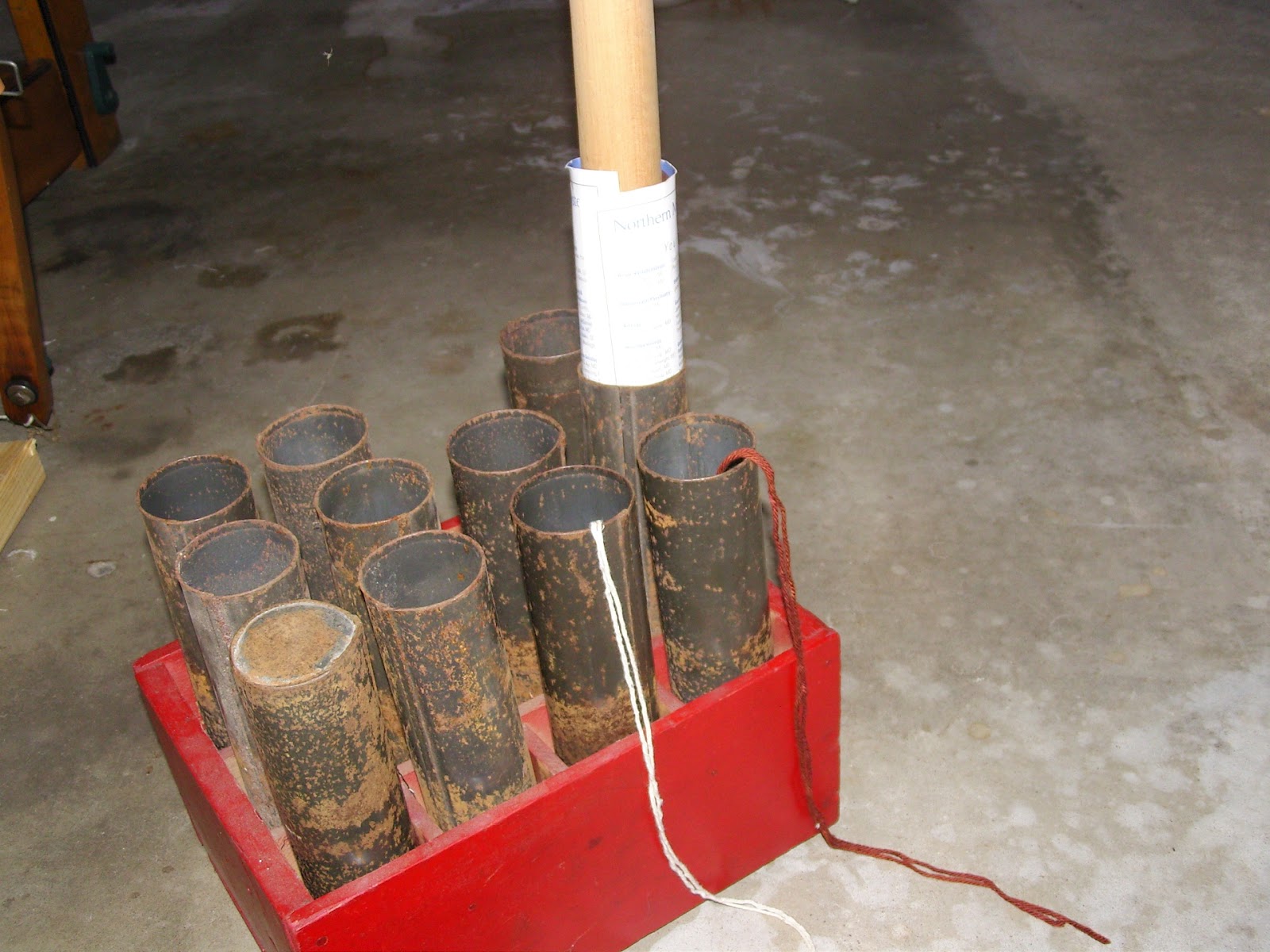
The canisters took a little getting used to to load them. I didn't get a "pink pony" with the loom so I had to do it by hand. I found a pretty thick dowel in the workshop to compress the weft material into the tubes, but it seemed to stick to the insides of the tube, so I tore the cover off an old phone book, and that slippery, heavy paper made it much easier to get the tube loaded. As I filled it a bit, I pulled the paper out more, so I always had a deep tube. My tubes are still rusty, but not so bad on the inside, so no, my fabric did not pick up rust.
The yarn poking out of a couple of the tubes makes good hems on the rugs. It is about the weight of the Sugar and Cream type yarn used to knit dishcloths. I use two strands and get a hem like the white and rust sections with the closer chicken tracks. I do have an industrial sewing machine to sew the thick hems. I could do it on my regular sewing machine with some special techniques, because the yarn is soft, but I don't need to, since the heavy machine is designed for that type sewing. Chicken Tracks even makes a nice hem!
This machine travels! The 2x4s on the floor were braced against the front corners, but they only help a little bit, and then I have to tug at the loom and move it back. I actually think I need to brace it in two directions, since it tends to move forward and to the left. I will have to work on that when I find a more permanent location for the loom. Right now it is in the garage where my car will be this winter.
The tension adjustment on the brake band will determine how far forward the beater will come when beating the rug. Much further back from the front post than this amount will start causing problems with the shed changing mechanism and the fly shuttle mechanism.
I have found that this distance is about ideal, but not any closer.
Broken warp threads seemed to be inevitable, so I quickly learned to leave plenty of extra warp on the repair section. That way, I had enough to pull forward through the heddle and reed and could get the knots between rugs once I finished the rug I was on. Leave enough warp behind the loom to finish the current rug, and enough to weave the next rug. It will save headaches of having knots that you have to keep an eye on behind the heddles.
I like weaving rugs while standing. I think it is easier on my shoulders, and the leverage is great. I never missed the treadles even once!
I thought I learned to keep an eye on the nuts and bolts, to make sure they stayed tight, and then I looked down at the floor, and the nut and washer under the tension rod was on the floor. Before the next warp, I will have to go over the whole loom and tighten everything and oil all the moving metal parts.
Another bolt that I had to keep an eye on was the big bolt holding on the cams. With the loom warped, it isn't visible, so it's an easy one to forget about. It has to be pretty tight, or it will constantly come loose.
All in all, I think I had a pretty successful first warp. I'm anxious to start learning more with my next one.
How satisfying to see a nice roll of rugs on the cloth beam. They will have to wait until tomorrow evening to be removed, since I still have a bit of warp left that I will make into a sample.
Along the way, while weaving this first warp, I learned some things about the loom. This was my first experience with sectional warping, and it is obvious that Bob and I have to be a little more careful with counting rotations, as evidenced by the photo. Oops! That little bit left to weave will be my sample, and then I am going to undo the edge sections and finish up the warp with a couple placemats on the narrower warp.
Also seen in the bottom edge of the photo are weights that I used on my last four edge threads on each side. I'm hoping with the weighted selvedges, that I won't have wavy edges.
The canisters took a little getting used to to load them. I didn't get a "pink pony" with the loom so I had to do it by hand. I found a pretty thick dowel in the workshop to compress the weft material into the tubes, but it seemed to stick to the insides of the tube, so I tore the cover off an old phone book, and that slippery, heavy paper made it much easier to get the tube loaded. As I filled it a bit, I pulled the paper out more, so I always had a deep tube. My tubes are still rusty, but not so bad on the inside, so no, my fabric did not pick up rust.
The yarn poking out of a couple of the tubes makes good hems on the rugs. It is about the weight of the Sugar and Cream type yarn used to knit dishcloths. I use two strands and get a hem like the white and rust sections with the closer chicken tracks. I do have an industrial sewing machine to sew the thick hems. I could do it on my regular sewing machine with some special techniques, because the yarn is soft, but I don't need to, since the heavy machine is designed for that type sewing. Chicken Tracks even makes a nice hem!
This machine travels! The 2x4s on the floor were braced against the front corners, but they only help a little bit, and then I have to tug at the loom and move it back. I actually think I need to brace it in two directions, since it tends to move forward and to the left. I will have to work on that when I find a more permanent location for the loom. Right now it is in the garage where my car will be this winter.
The tension adjustment on the brake band will determine how far forward the beater will come when beating the rug. Much further back from the front post than this amount will start causing problems with the shed changing mechanism and the fly shuttle mechanism.
I have found that this distance is about ideal, but not any closer.
Broken warp threads seemed to be inevitable, so I quickly learned to leave plenty of extra warp on the repair section. That way, I had enough to pull forward through the heddle and reed and could get the knots between rugs once I finished the rug I was on. Leave enough warp behind the loom to finish the current rug, and enough to weave the next rug. It will save headaches of having knots that you have to keep an eye on behind the heddles.
I like weaving rugs while standing. I think it is easier on my shoulders, and the leverage is great. I never missed the treadles even once!
I thought I learned to keep an eye on the nuts and bolts, to make sure they stayed tight, and then I looked down at the floor, and the nut and washer under the tension rod was on the floor. Before the next warp, I will have to go over the whole loom and tighten everything and oil all the moving metal parts.
Another bolt that I had to keep an eye on was the big bolt holding on the cams. With the loom warped, it isn't visible, so it's an easy one to forget about. It has to be pretty tight, or it will constantly come loose.
All in all, I think I had a pretty successful first warp. I'm anxious to start learning more with my next one.
Sunday, September 2, 2012
More Rugs
I have mixed feelings about weaving rugs. They weave fast if there isn't any variation to them, but I seem to be most attracted to the ones with stripes or more detail. There is such a lot of prep work that goes into a nice rug, that it usually takes longer than weaving it. Prepping is a lot of hard work, and some can be hard on the body. My hands are getting pretty sore, so I may soon have to take a break and get back to finer weaving with just yarn.
I ran into a little difficulty today weaving this small rug. This is the third rug I have made on the Weaver's Delight, and the manual warned about checking the bolts for tightness. Things started to loosen up, and suddenly I couldn't make anything move. Being new to the loom, it took me a bit of looking before I figured the trouble was with the "A" part needing to be scooted a little to the left, toward the "B" part. I was able to complete the rug, but it started doing it again just as I was finishing the hem. I will get back to it tomorrow, in the daylight, when I can see what I'm doing.
Most of the rugs I am weaving are probably going to go up for sale. Our church regularly goes on a mission trip to Kentucky every year, and they need to raise the funds for any repair projects they sign up to do. Hopefully, I will have a stack of rugs before next years trip.
I actually wove this rug for us. We needed a small rug by the tub/shower that wouldn't cover the heat register on the floor. The light colored fabric is a recycled mattress ticking. I like how the striped fabric looks when woven. The rest of the fabrics are from my large stash, chosen to match the colors in the shower curtain. I'm determined to gradually whittle away at the many boxes of fabric upstairs in my studio.
The 8 1/2 yards of warp that I put on the WD is quickly coming to an end. I will probably get one or two more rugs from it, and then I will probably try the plain weave cams on the next warp.
Sunday, August 26, 2012
Davey Weaves on the Weaver's Delight
My 10 year old grandson Davey was over to our house today with his mom and little brother. He got a chance to try out the Weaver's Delight loom. I let him weave the final hem on the second rug. He got the hang of it quickly.
This is my first attempt at adding a video. I took it with my daughter's phone, and just previewed it. It is a bit blurry, especially if it is expanded, but I thought it was cute, so it's staying. I am going to let Davey tell in his own words what he thinks of the loom.
He also told his mom that they needed to get a loom like it at their house!
This is my first attempt at adding a video. I took it with my daughter's phone, and just previewed it. It is a bit blurry, especially if it is expanded, but I thought it was cute, so it's staying. I am going to let Davey tell in his own words what he thinks of the loom.
He also told his mom that they needed to get a loom like it at their house!
Subscribe to:
Posts (Atom)