Gypsy Rose was finished at the same time I finished Hamish, but because she was a gift, I didn't write about her right away, and then I got sick and didn't have the energy or desire to write. I decided today, that I can't wait any longer. She needs her story told.
As many of the other bears were, she was finished on a trip to visit Bob's parents. I think she has the sweetest face of all the bears, and just calls out for cuddling.
Hamish is on the left and Gypsy Rose is on the right.
Fortunately, some of the bears live close by, so she got to meet Othar and Benjamin one day when Davey and Bobby brought their bears over to my house.
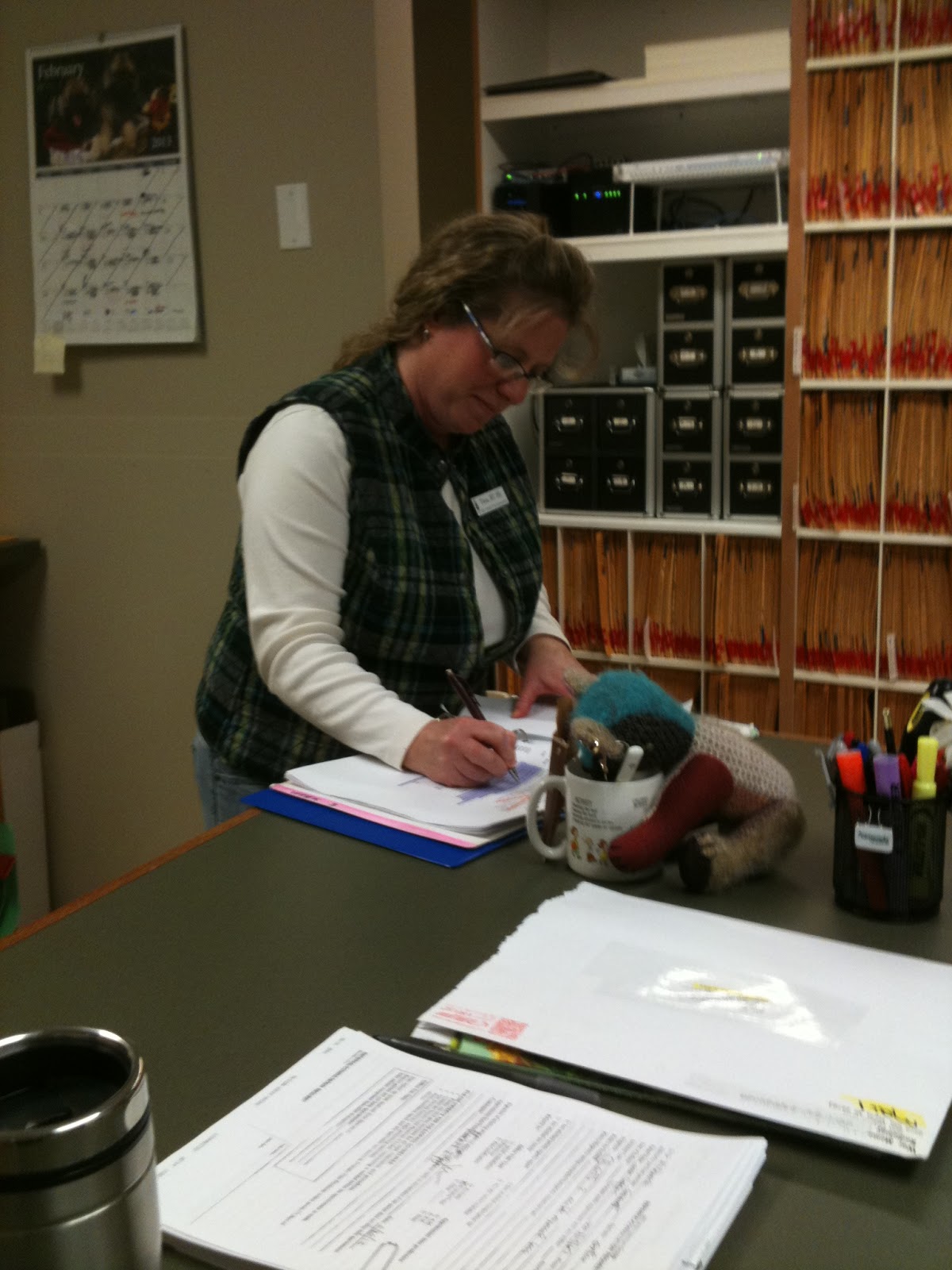
In February, it was "Take Your Bear to Work Day" at Bay Street Orthopaedics, so I decided to take this bear. My co-worker Tina helped come up with the name Gypsy Rose. She is helping Tina with some of her work. It's a good thing that was just temporary information, because Gypsy got hold of Tina's pen and scribbled all over the paper.
Gypsy Rose is being a little Nosy Parker here, sniffing at one of her favorite foods in the cup. Tina ended up sharing her oatmeal with her, since it would have been rude to eat in front of a baby bear!
I decided when I started making the last two bears that one would be for my daughter-in-law Jenn's birthday. The trouble was that Jenn's birthday was quite a while after Gypsy Rose was finished. I started feeling bad that she was the only bear left to be adopted. One day in April, Jenn called me and said she was in Traverse City, so I quickly wrapped the present and headed to Jenn's mom's house where they were having a ladies family gathering.
Jenn had seen a few photos of Gypsy Rose and was hoping she was going to be for her. She was surprised and a little teary-eyed when she opened the early birthday gift.
I am so happy Gypsy Rose got to go to a home where she will be loved, and will get to live with four of the Griswold bears. Hopefully they will all have some wonderful adventures.
Deb, Jenn's mom, also fell in love that night with Hamish. I let him come along with me so he could see who was going to be Gypsy Rose's mom.
I don't think it is possible to be too old to love a Teddy bear. I am thankful that all of Griswolds and Left-Overs have such wonderful new homes and mommies and daddies.
These will probably be the last bears. Maybe their moms and dads will write about more of their adventures.
Thursday, July 11, 2013
Friday, July 5, 2013
Weaver's Delight "Pink Pony" Stuffing Machine and Rigby Cutter
I finally got motivated to get back to my blog today. I was given a "pink pony" stuffing machine by our friend Lou down in Missouri when Bob and I were on vacation in April. I haven't been feeling well since then, so have only been doing dibs and dabs with weaving lately. I finally took enough photos to show how I prepare denim strips and load them in the tubes for weaving.
Preparing denim jeans for rugs is labor intensive. They are plentiful at the resale shops and from friends, so I don't make any effort to open seams, remove pockets, or take out hems. I trim around all those areas and then make one fairly straight edge on one side.
I purchased a strip cutter on eBay because my hand can't take the heavy cutting for any length of time with the rotary cutter any more. This particular cutter is a Rigby Cutter. It is pretty old, but it has been working pretty well for me. I would have preferred a Fraser Cutter, since there are more options for parts. They cost more than I was able to spend though.
The red cutter is adjusted away from the cutter blade for the strip width I want. I use strips that are about 3/4" - 7/8" wide for a twill weave rug. I would probably cut them 1/2" for plain weave rug. Anything wider than that and it is almost impossible to get the strips tightly packed.
Turn the crank and it cuts the strip.
When I get enough strips cut with various colors, I take a bundle of them and sit with them on my lap and cut a 45 degree angle at each end. I usually do all one end, then flip them around and do the other end. The angle must be in the same direction at both ends.
Here is a bundle that is probably enough to stuff 2-3 tubes for the shuttles.
I overlap them about 1/4" and triple-stitch zig-zag the ends together.
The strips feed through the shuttle better this way, and I have fewer hang-ups then if I use a 45 degree seam.
I sew them in a continuous strip until it is hard to sew any more. They loop around in front of the machine and eventually there isn't any more space to sew.
I clip my threads when I'm done sewing and pull them out from under the presser foot. They will curl into a spiral and that needs to be straightened out before running the strip through the stuffing machine.
The fabric strip is threaded through the eyelet guide in front of the left concave roller, then brought over the top of the roller and drops into the funnel below. The convex roller is brought forward against the fabric strip.
As seen in this photo, I straightened my strip into a container on the floor. While turning the large wheel with the leather belt, the pole is used to poke the strip down into the tube and pack it tight.
Here is a tube loaded into a shuttle.
This rug is getting close to being complete. Three more tubes will probably be enough.
I am using a twill tape to keep track of the rug length and the temple that came with the loom to help keep a consistent width to the rug.
Preparing denim jeans for rugs is labor intensive. They are plentiful at the resale shops and from friends, so I don't make any effort to open seams, remove pockets, or take out hems. I trim around all those areas and then make one fairly straight edge on one side.
I purchased a strip cutter on eBay because my hand can't take the heavy cutting for any length of time with the rotary cutter any more. This particular cutter is a Rigby Cutter. It is pretty old, but it has been working pretty well for me. I would have preferred a Fraser Cutter, since there are more options for parts. They cost more than I was able to spend though.
The red cutter is adjusted away from the cutter blade for the strip width I want. I use strips that are about 3/4" - 7/8" wide for a twill weave rug. I would probably cut them 1/2" for plain weave rug. Anything wider than that and it is almost impossible to get the strips tightly packed.
Turn the crank and it cuts the strip.
When I get enough strips cut with various colors, I take a bundle of them and sit with them on my lap and cut a 45 degree angle at each end. I usually do all one end, then flip them around and do the other end. The angle must be in the same direction at both ends.
Here is a bundle that is probably enough to stuff 2-3 tubes for the shuttles.
I overlap them about 1/4" and triple-stitch zig-zag the ends together.
The strips feed through the shuttle better this way, and I have fewer hang-ups then if I use a 45 degree seam.
I sew them in a continuous strip until it is hard to sew any more. They loop around in front of the machine and eventually there isn't any more space to sew.
I clip my threads when I'm done sewing and pull them out from under the presser foot. They will curl into a spiral and that needs to be straightened out before running the strip through the stuffing machine.
As seen in this photo, I straightened my strip into a container on the floor. While turning the large wheel with the leather belt, the pole is used to poke the strip down into the tube and pack it tight.
Here is a tube loaded into a shuttle.
This rug is getting close to being complete. Three more tubes will probably be enough.
I am using a twill tape to keep track of the rug length and the temple that came with the loom to help keep a consistent width to the rug.
Tuesday, April 23, 2013
Hamish Loves His New Clothes
I mentioned before that Bob's bear Hamish is named for one of the characters in the Braveheart movie. I have had it in the back of my mind for a little while that he needed some clothes to go along with that character.
I wanted to go to Petoskey yesterday to visit my daughter Becky, and asked Bob if I could take Hamish along with me. He said that was a good idea, since he was going to work and thought it would be good for Hamish to have an adventure.
Becky and I had talked about making the bear a kilt, so she got out her selection of plaid wools and Hamish picked out the pretty blue one. He knew his daddy would like it because it was a color he could see (Bob is color blind, but can see blue).
Hamish is sitting here while Becky is cutting the fabric after she took some measurements for his kilt. She needed a long strip of fabric for pleating.
Hamish is "helping" her pin the pleats. He learned about sharp pins the hard way! Ouch!
The pleats were stitched down and then he tried on the kilt. It looks just about right. I took it to the ironing board to press the pleats, so it would look nice and swishy when he moves. Guys and kilts are just about as bad as little girls with their twirly dresses.
While I was pressing, Becky got out her leather, punch, and buckles and created a belt.
She is making the final adjustment before trimming it to the right length. Hamish is quite proud of his REAL leather belt and big buckle!
Well, isn't he a handsome lad?!
The over the shoulder cloth really adds to the outfit, and pressed pleats really are swishy!
Bob and Hamish both are quite happy with the outfit. Happy birthday from Becky!
The Left-Over bears and all the other Griswold bears have been one of my favorite projects.
Stay tuned for the story of Gypsy Rose, which will be coming soon.
I wanted to go to Petoskey yesterday to visit my daughter Becky, and asked Bob if I could take Hamish along with me. He said that was a good idea, since he was going to work and thought it would be good for Hamish to have an adventure.
Becky and I had talked about making the bear a kilt, so she got out her selection of plaid wools and Hamish picked out the pretty blue one. He knew his daddy would like it because it was a color he could see (Bob is color blind, but can see blue).
Hamish is sitting here while Becky is cutting the fabric after she took some measurements for his kilt. She needed a long strip of fabric for pleating.
Hamish is "helping" her pin the pleats. He learned about sharp pins the hard way! Ouch!
While I was pressing, Becky got out her leather, punch, and buckles and created a belt.
She is making the final adjustment before trimming it to the right length. Hamish is quite proud of his REAL leather belt and big buckle!
Well, isn't he a handsome lad?!
The over the shoulder cloth really adds to the outfit, and pressed pleats really are swishy!
Bob and Hamish both are quite happy with the outfit. Happy birthday from Becky!
The Left-Over bears and all the other Griswold bears have been one of my favorite projects.
Stay tuned for the story of Gypsy Rose, which will be coming soon.
Monday, April 8, 2013
The Pink Pony and the Third Left-over Bear
While on vacation last week, Bob and I visited weaving friends, Lou and Betty, down in Arkansas. Lou has several Newcomb looms, but doesn't use the flyshuttle mechanisms on them. When I told him I bought a Weaver's Delight loom to restore but it didn't come with the tube stuffing machine (the pink pony), he offered the one he didn't use to me. Thanks Lou!!
We went down to Arkansas on Bob's birthday, and while we were at Betty and Lou's house, I gave Bob his present. I found out he never had a Teddy bear as a child, so I gave him my third left-over bear, T14. Bob named him Hamish (pronounced Hay'-mish) after a character in the Braveheart movie.
We had a bit of fun with Hamish as we traveled home this past Saturday. I taught him how to read a map so he could help his daddy with navigation.
We played our usual game of cows and horses, getting points for them on our side of the road, and extra points for white ones. If we passed a cemetery on our side of the car, we lost our points.
Hamish kept telling me he wanted to ride the pony, and I thought he was talking about one of the ponies in our game. Then it dawned on me that he overheard us talking about the pink pony, and that was what he meant! When we stopped in Hannibal, Missouri for lunch, we got the pony out and let him ride.
Hannibal was kind of exciting for Hamish. He threw his arms up in the air when he saw his first train! "Here comes the train! Here comes the train! Yipee!!" he started to yell. He was jumping around so much, Bob had to hold on to him for dear life, since that fence rail was right over a cliff!
The rest of the trip was uneventful. We did see the statue of Mark Twain and then a couple more trains in Indiana. I suppose there will be more train-watching trips in Hamish's future.
We are glad to be home, but not glad for the cold and snow. It's melting quickly though, and spring is promising to be here soon. Snowdrops are blooming and daffodils will be showing their sunny faces with a bit warmer weather.
We went down to Arkansas on Bob's birthday, and while we were at Betty and Lou's house, I gave Bob his present. I found out he never had a Teddy bear as a child, so I gave him my third left-over bear, T14. Bob named him Hamish (pronounced Hay'-mish) after a character in the Braveheart movie.
We had a bit of fun with Hamish as we traveled home this past Saturday. I taught him how to read a map so he could help his daddy with navigation.
We played our usual game of cows and horses, getting points for them on our side of the road, and extra points for white ones. If we passed a cemetery on our side of the car, we lost our points.
Hamish kept telling me he wanted to ride the pony, and I thought he was talking about one of the ponies in our game. Then it dawned on me that he overheard us talking about the pink pony, and that was what he meant! When we stopped in Hannibal, Missouri for lunch, we got the pony out and let him ride.
Hannibal was kind of exciting for Hamish. He threw his arms up in the air when he saw his first train! "Here comes the train! Here comes the train! Yipee!!" he started to yell. He was jumping around so much, Bob had to hold on to him for dear life, since that fence rail was right over a cliff!
The train was passing over the Mississippi River from Illinois and entered a tunnel through the hill. Bob knows all the good train-watching spots and we were fortunate one came along before we got on the road again.
Baby Teddy bears do get tired, especially when they try to stay awake for the whole trip. Hamish was so afraid he was going to miss something! He made up for it on Sunday we got home, spending most of the day sleeping.
Saturday, March 16, 2013
Mitering Corners on Handwoven Lace
A weaver recently asked me how I miter corners. Photos are so much better than words, or really help the words, and anyone that has read my blog knows that is what I do best. It is a long post, but here is the end result, all ready for tea.
When I first started to weave, I took a nine month long class called Weaver's Boot Camp. This particular class assignment was to design a two-block lace pattern and weave 4 place-mats. Woven lace is a loom generated fabric that has holes in it. I chose Swedish Lace with lattice hem-stitching and made table napkins, instead of place-mats because my yarn was pretty fine. I have included my finishing technique for mitering corners with these step-by-step instructions and photos. Feel free to borrow, but please include a link back to this post. Thank you.
Wet finish the piece and steam press before starting so the weaving yarn is set. Turn edge in 1/4" and press.
A chalk line is marked diagonally on the corner from hem crease line to crease line.
If you are trying this without the hem-stitching, you will need to determine how deep your hem will be. From the finished photo above, you can see that mine is a fairly deep hem, folding up to the first edge of the first hem-stitching row. You may want to chalk mark that also.
Fold corner, hems and right sides together. Stitch on chalk line, from hem fold (not the edge) to diagonal fold. Use a fairly small stitch. Back stitch both ends.
Note that the stitching only goes to the hem fold, not the edge. Trim the seam to 1/4". The hem is not turned down while trimming.
At this point, if your fabric ravels easily, you could carefully treat the cut edge with Dritz Fray Check. It is a permanent treatment, and is a bit stiff, so make sure it doesn't soak through to any area that will be on the outside.
Turn the pressed 1/4" edge hem on both sides.
Dampen corner and finger press diagonal seam open. Raveling can be a problem, so use care.
Carefully turn the corner, gently working the point out with a blunt object. I used a medium sized crochet hook.
Fold hem and pin in place. Repeat for the other 3 corners.
Hand or machine stitch hem. I like to finish mine on the sewing machine. I set the zigzag so it will catch one thread of the hem...
and then one stitch into the hemstitching space. Adjust the stitch length to try and avoid hitting the hem-stitching threads. If your thread matches the fabric, you will be unable to tell that it is machine stitched unless you examine it very closely.
If you are doing mitered hems without the hemstitching, the machine stitching can be a straight stitch.
Done and ready for pressing!
When I first started to weave, I took a nine month long class called Weaver's Boot Camp. This particular class assignment was to design a two-block lace pattern and weave 4 place-mats. Woven lace is a loom generated fabric that has holes in it. I chose Swedish Lace with lattice hem-stitching and made table napkins, instead of place-mats because my yarn was pretty fine. I have included my finishing technique for mitering corners with these step-by-step instructions and photos. Feel free to borrow, but please include a link back to this post. Thank you.
Wet finish the piece and steam press before starting so the weaving yarn is set. Turn edge in 1/4" and press.
A chalk line is marked diagonally on the corner from hem crease line to crease line.
If you are trying this without the hem-stitching, you will need to determine how deep your hem will be. From the finished photo above, you can see that mine is a fairly deep hem, folding up to the first edge of the first hem-stitching row. You may want to chalk mark that also.
Fold corner, hems and right sides together. Stitch on chalk line, from hem fold (not the edge) to diagonal fold. Use a fairly small stitch. Back stitch both ends.
Note that the stitching only goes to the hem fold, not the edge. Trim the seam to 1/4". The hem is not turned down while trimming.
At this point, if your fabric ravels easily, you could carefully treat the cut edge with Dritz Fray Check. It is a permanent treatment, and is a bit stiff, so make sure it doesn't soak through to any area that will be on the outside.
Turn the pressed 1/4" edge hem on both sides.
Dampen corner and finger press diagonal seam open. Raveling can be a problem, so use care.
Carefully turn the corner, gently working the point out with a blunt object. I used a medium sized crochet hook.
Fold hem and pin in place. Repeat for the other 3 corners.
Hand or machine stitch hem. I like to finish mine on the sewing machine. I set the zigzag so it will catch one thread of the hem...
and then one stitch into the hemstitching space. Adjust the stitch length to try and avoid hitting the hem-stitching threads. If your thread matches the fabric, you will be unable to tell that it is machine stitched unless you examine it very closely.
If you are doing mitered hems without the hemstitching, the machine stitching can be a straight stitch.
Done and ready for pressing!
Subscribe to:
Posts (Atom)