Wednesday, January 26, 2011

Free Sleying Hook

Here is one of my favorite weaving tools.  The weaving craft can get kind of expensive, but this sleying hook is free.

 I use the fake credit cards that come in the advertising from credit card companies.  I tend to misplace things, so if I only had one sleying hook, I probably wouldn't get much weaving accomplished.  By making my own, I can have one or a dozen by each loom.  If I accidently drop one, I just pick up another one and keep going.


This wasn't my own idea.  I had heard of someone making them, but drew my own pattern.  It is designed so the tips just fit corner to corner on the card.  (The pattern in the photo is drawn on a piece of paper.)  Cut out the pattern and trace around it with a Sharpie marker onto the card.  Cut the card with heavy scissors, except the circular area of the hook.  Use a hole punch for that spot.  Make sure all the edges are smooth, so they don't snag the yarn.


I make sure I give a couple to each new weaver I get a chance to teach.  This photo is of me in my weaving studio in the garage.  It's a bit chilly out there this time of year, so I decided to bring one of my small looms inside.  I just started some hand towels with Atwater-Bronson lace pick-up, using some of my designs.

Have a great time weaving!  I know I am!

Tuesday, January 4, 2011

Tips for Serging Rag Rug Strips

There was a discussion recently on RugTalk (an online group for people interested in weaving rugs), about sewing rag strips together with a serger to prepare them for weaving. Although I have two sergers, I haven't used this method myself for rugs. My reasons for not using the serger are that I think I can do it just as quickly with my regular sewing machine, the serger uses more thread, and the seam isn't as stable as one made with a sewing machine.


The main positive reason I can think of for using the serger is that it saves some time trimming the little triangle away from the seam, since the serger does it while sewing the seam.


Don't think that because the serger has a cutter, it should be used to cut your fabric strips. It isn't a very fast method, and will quickly wear out the two blades on the serger, and eventually wear out the motor.


I would wait for a sale at the fabric store and purchase a rotary cutter, gridded cutting mat, and gridded 6" x 24" thick ruler like in the photo. The advantage to using the rotary cutter is that several layers of fabric can be cut at once, your width will be consistant, and it is FAST. Remember to keep the blade locked when you aren't cutting. If it accidently falls off your table, it is less likely to nick the blade or cut the dog or your foot!


Here are some tips to use a 3/4 thread serger. First of all, I would use the 4 thread (two needle) stitch to sew the strips together. The 3-thread stitch pulls apart too easily.


This is an example of a serged seam using 4 threads. The top of the seam is on the left and the underside is angling down. There are two straight stitches made by the needles, and the wavy back and forth threads are made by the upper and lower loopers. The straight stitches are only seen on the top side. If the tensions are properly balanced, those two straight rows of stitching only show on the top, and on the reverse side only as a tiny dot. The straight line down the center of the seam serves the purpose of making a more stable seam. It is harder to pull apart a 4-thread seam.


This is an example of a 3-thread seam. It looks the same on both sides of the seam. It doesn't have the added stabilizing thread, and a seam sewn with this can pull apart much easier. To be properly balanced, the tensions are adjusted till the threads interlock right at the edge. There are good uses for this stitch. It is a bit stretchier, so it is sometimes used in knit clothing seams. It will also stabilize an edge of fabric to prevent raveling.


This is an example of a three-thread seam that can pull apart quite easily.


Strips are cut and ready to start sewing together. For illustration purposes only, I have marked the stitching line on the fabric. The two strips are placed right sides together at a right angle. They will be sewn together with an angled seam to reduce bulk in one spot when weaving, so the rug won't look lumpy bumpy.


The toe on the serger presser foot has marks indicating where the two needles seams will be. The seam ripper is pointing at the mark where the outer needle will stitch. Line up the corner of the top fabric with that mark.


Stitch the seam. A little triangle of fabric will be trimmed off as the seam is sewn. When the end of the fabric gets to the front of the presser foot, flip the other end of the top fabric over so the right side is up, and add your next strip.


Continue sewing, without cutting the thread between, till quite a few are sewn together.


Clip the strips apart.


Fold strip in half. Seam is spread out in a "V", reducing bulk in one spot. A serger leaves chains of thread. If you gently pull on them, the looper threads will slide off the needle threads. Clip the tails.

Wind folded strips onto shuttle and weave a beautiful rug.

I still personally think that clipping all those tails, even if they are shorter than shown in the picture, take just as much time as sewing on a sewing machine, snipping the chain of strips apart, and trimming the small triangle off. Try it both ways and decide for yourself. Happy weaving!


Friday, December 31, 2010

Tips for Rag Rug Hems, Additional photo

In May and August, 2010, I wrote two entries with rag rug tips.  When reviewing my instructions today, I realized I should have had a photo showing my method for weaving the hems for rag rugs. 

Like many others, I dislike fringe on my rugs because they gradually wash away in the laundry, especially with cotton warp.  I prefer to weave about three inches in plain weave (1-3 vs 2-4) at the beginning and end of my rugs, so I can fold a hem about 3/4" to 1" wide.

When I first started adding a hem, I had the problem many other weavers have, with the hem drawing in much narrower than the body of the rug.  I do a lot of reading, and came across this tip, and it solved the problem:

Instead of weaving the hem like I weave the body of my rug (1-2 vs 3-4, giving me doubled warp threads), I use tabby.  Instead of angling the weft in the shed, I arc the weft, and throw a few bubbles in for good measure (see photo).
It gives a stretchy hem with very little draw-in.  By the time an inch is woven, the weaving at the edges will even out a bit.  The first inch doesn't matter too much, since it is folded into the hem and won't show.  Play around with the arc size and the amount of bubbling till you get a hem that isn't drawing in. 

Sewing the hem takes some other techniques, but I will have to save that for another time, when I have a rug finished and ready to hem.  My technique avoids broken sewing machine needles.  Stay tuned.  Happy New Year!

Sunday, December 12, 2010

Davey Finished Weaving His First Project

 I am so proud of my grandson Davey.  He is eight years old, and when he came for a weekend at the end of November, we did some weaving.  He had been practicing on the rigid heddle loom, and was doing a great job, so I thought he was ready to start a pattern on my little four shaft loom. 

Here he is demonstrating the proper way to hold a shuttle.  He is doing very well throwing it through the shed and catching it.
Davey finished weaving today.  He is pretty proud of what he made.
I showed him how to wet finish it in hot soapy water till the water looked clean.  After rolling it in a towel to get most of the moisture out, he straightened it out on the counter and rolled it hard with the marble rolling pin.  It is hanging to dry now.  Hemming will be tomorrow after I get home from work.

Monday, December 6, 2010

Sampling Wool - Angora Yarn

As part of my stash reduction, I picked out a yarn that I thought would make a nice little handbag.  I purchased two cones of wool mixed with angora yarn at an estate sale a while ago.

I got out my notes from a Magic in the Water workshop that I went to a while ago.  We made several samples with different wools, so I was able to compare my yarn with some of the yarns we used in the class.  Mine was similar to one that was sett at 10 epi, so that was my starting point. 

I checked out the shrinkage and decided that 10" in the reed would work.  I liked it already, since that was only 100 ends!  I wanted to make about six bags, plus have some to play around with, so I measured out about ten yards.  On the warping reel, it went quickly.

It was important to see how much the fabric would full, so I wove off 24" and cut it off the loom.  Staying up way too late last night, I did the wet finishing.  I agitated it by hand in hot soapy (Dawn) water for about 4-5 minutes.  I changed the water a couple times so the water would stay hot.
The sleazy cloth that came off the loom measured 9" W by 21" L without tension.  When the fulling was complete, I measured the sample again.  This time it was 8 1/2" by 18 1/2" L.  I could tell that it was going to be soft, even though it was still wet.  I heat set it by pressing between a couple towels.  After the pressing and air drying, the final measurement was 7 3/4" W by 18" L, for a loss of 3" in the width and 6" in length.  Definitely a cloth to dry clean or gently hand wash in cool water.

When I got up this morning, it was dry, and so soft. Notice the fine angora hairs on the edge.  The whole cloth has a halo.   It was no longer a sleazy texture. 

I plan on trying some other weaves and some experiments with dyeing using Kool Aid and Wilton food colors.  Here is a link to a description of the process:  Dyeing animal fiber with Kool Aid and Wilton food coloring

If it is not too hard, I will have a good project for grandchildren.

Sunday, November 28, 2010

More Stash Reduction

I know I am calling it stash reduction, but when I look at my stash after completing a project, it doesn't look like anything has changed!  I suppose others experience the same thing.  I can say though, that the recent projects did not involve buying anything new, and some of the materials were given to me.
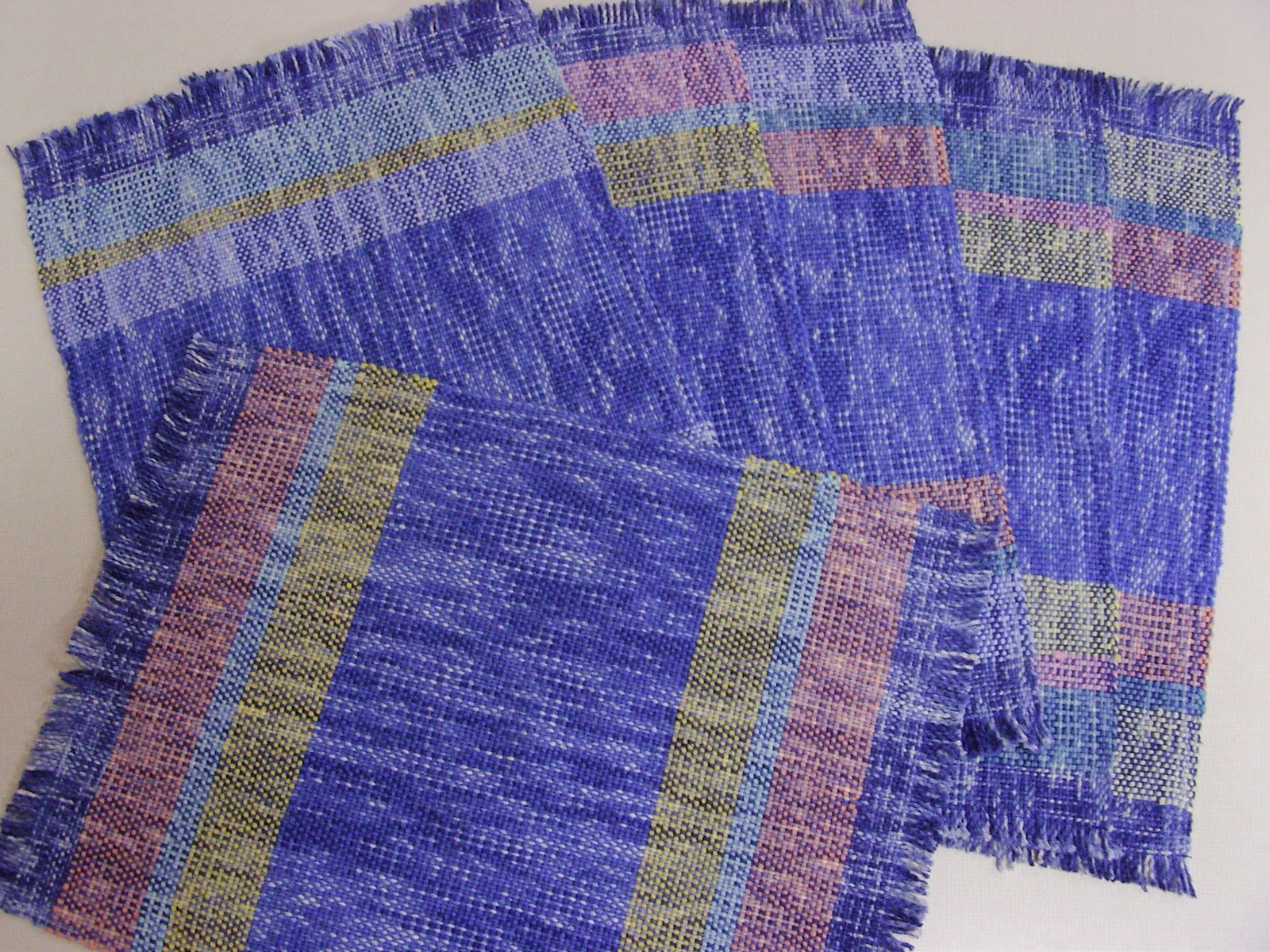
The first project was a set of six placemats that I started a while ago.  I have a huge cone of fairly heavy cotton yarn that is dyed a varigated dark blue to white.  I have used it a lot, and the cone still looks big.  When our son Edwin told us he was getting married, I set to work finishing the placemats for Rebecca's bridal shower.  Her favorite color is blue, so it was perfect for her.


The weft yarn was from my vast stash of fairly heavy cotton yarn that was given to me a couple years ago. Both yarns used in this project have been used many times for teaching children to weave. It's a great weight for making a project weave quickly, and still end up with something that is usable.


My eight year old grandson, Davey, spent a few days with Grandma after Thanksgiving Day.  He had been doing some weaving on a rigid heddle loom, and was quite meticulous with his work, so I thought he was ready to move on to a four shaft loom. 
There was warp left over on the placemat loom, so we looked in the Davison book for a few choices for him.  Since it was already threaded 1-2-3-4, he decided on a 2-2 twill that reverses direction with color changes.  We decided that some white yarn and some different colors of green yarn that I had left over from another towel project would work well. 
 I only got videos of him working on the four shaft table loom, but I did get a couple pictures of his work.
His selvedges look great and he is being pretty consistant with his beat.  He was easily distracted though, so he only got a little bit done.  Guess Grandma will have to have him over again soon!


While Davey was weaving on his project, I finished up a rag throw rug made with wool fabric strips that a friend gave me.  It was a design as I go type rug, with the stripe width being determined by the amount of a particular fabric.  There were several different plaids and a few plain fabrics.  I decided to seperate the different plaids with plain strips.  To add a little interest to the plain fabric area, I twisted two colors together.  That was ok for a couple rows at a time, but I wouldn't want to do a whole rug like that because the twisting takes too long.
I am pretty happy with how it turned out.  After putting it down on the floor, I thought the colors would look nice in our bathroom, since the colors are similar to the colors on the "rustic" shower curtain.
 With the rug done, I got back to the linen warp and wove another towel.  This is still from pg 39 of Davison's book, weaving version II.  It is a single shuttle pattern, and goes very quickly.  Since I used a cotton varigated yarn with slubs, the pattern isn't real distinct.  It shows better on the closeup photo.  The yarn is varigated blue, turquoise, green, and lavender. 
Hopefully I have enough warp for at least one more towel.  I think I will do this version again with a solid color yarn.


All in all, I think I had a pretty productive last few days.

Wednesday, November 24, 2010

Question About Threading Front to Back (F-to-B)

Sharon asked me why I used a raddle to thread my linen warp if I was threading F-to-B.

Actually, I didn't use the traditional method of threading because all I had was a large bundle of warp threads, about 4 yards long.  It was cut at both ends and there was no cross.  This would definitely be considered slow cloth!

Sharon, this threading was kind of a hybrid of front to back.  I used a raddle because I started with threading the heddles first from the center out to each side.  I put lease sticks in behind the heddles and threaded a cross with it as I was threading the heddles.  I tied the warp to the bar on the back beam, and then counted the correct number of ends per inch in the lease sticks and placed them in the raddle.  I did that from the center out to the sides also.


 I didn't sley the reed till I was all done beaming the warp, so the raddle was used to keep it the correct width.  The tow linen was so sticky, I didn't want more than one thing for it to catch on.

I don't usually thread f-to-b, although that is how I originally learned (from Deborah Chandler's book).    The multicolored warp with lots of pattern changes that I did for towels a while ago needed to be threaded that way.

If you haven't finished threading your loom f-to-b, find a way to weight your warp as you wind it on the back beam.  You can weight it in several bundles, as long as they all have the same amount of weight.  Stretch the warp out a ways  from the front of the loom to keep tangles to a minimum. Slap the warp to seperate any tangles.  Don't pull on individual warp threads.  Good luck.  I'm looking forward to seeing pictures once you get going on the weaving. 

To see Sharon's blog, go to: In Stitches

Sunday, November 14, 2010

Linen Towel Project

This week, I have been working on using more of my stash.  I purchased quite a lot of yarn at an estate sale a while back, and one of the things I bought was a large bundle of linen that was a cut off warp with no cross.  It was about four yards long, and a mix of a plyed smooth linen singles and tow linen singles. 
It's a good thing I am not a production weaver, because it took forever, or so it seemed, to get it on my Leclerc Artisat loom. 
Because the tow linen was so sticky, I decided to thread front to back so I could control the tangles better.  I worked with small bundles of pattern units and threaded the heddles first.  I wanted a cross, so as I threaded each bundle, I put the ends over and under my lease sticks attached to the back beam.


Once I threaded the heddles, added two floating selveges, and tied onto the backbeam, I was able to put some weights on the warp ends.  I moved the lease sticks to the front of the loom and worked it slowly toward the end of the warp.  The yarn was soooo sticky, and I was beginning to hope I wouldn't have to ditch the project.  Patience! 

It paid off!  But very slowly.  No warps broke while winding on the back beam. 


The warp is spaced 25 epi in a 15 dent reed.  It is sleyed 1-2-2.  The first dishtowel I am working on is mainly plain weave, with a border at each end.  The threading came from Marguerite Davison's book, Twill Miniature, on pg. 39.


 I'm using the first half of treadling #1 for the borders, with a little bit of plain weave between them.  With no tabby for this version, the weaving is going quickly.  So far, with tight tension, I have had minimal warp sticking together, but have had one broken warp thread so far. 


The weft is a turquoise blue 6/2 cotton, and seems to be working perfectly with the sett of the linen.  I love it when my guess turns our right the first time.  I wasn't planning on a towel with borders, but as I was spreading the warp and testing for correct threading, I kind of liked the look of it.  It is pretty typical of me changing the pattern in some way after I get started.

I use the Golden Ratio to determine the length of the towel and then use adding machine paper for a weaving guide to my towel length.   I can mark where the first borders are, and then mark where they should be on the other end of the towel.  Once the towel gets wound onto the front beam, I can't look back at what was woven.  I tend to get interrupted while weaving, and then forget what I did at the beginning, especially since I'm not a cookbook type of weaver.  My adding machine paper has saved me many a time, since I write a lot of notes on it, along with the inch marks.  It gets pinned to the edge of my towel while weaving with two pins.  It is kept loose, so I can see the whole length of the tape.  I use it again for the next towel if I am weaving something similar.
I'm hoping to get 3-4 towels out of this warp.

Monday, October 25, 2010

Back to Weaving

After a bit of time off, I am back to my looms and it feels good!  On October 12, 13, and 14, I took a trip downstate to attend a doubleweave workshop with a weaving friend.  It was taught by Jennifer Moore.  I had more information crammed into my brain that I will ever be able to use!  It was a great class. 
The class was run in a round-robin style, with everyone bringing their loom warped with an assigned pattern.  There were close to 20 in the class, so most of the patterns were on two looms.  
Jennifer gave 2 short lectures per day, and the rest of the time was spent weaving on each others looms.  Since I wasn't a speedy weaver, I didn't get to all of the patterns, but I did weave on several that interested me.  


The pattern assigned to me was a 2 block doubleweave windows. Some of Jennifer's samples of that structure are shown above and below. 

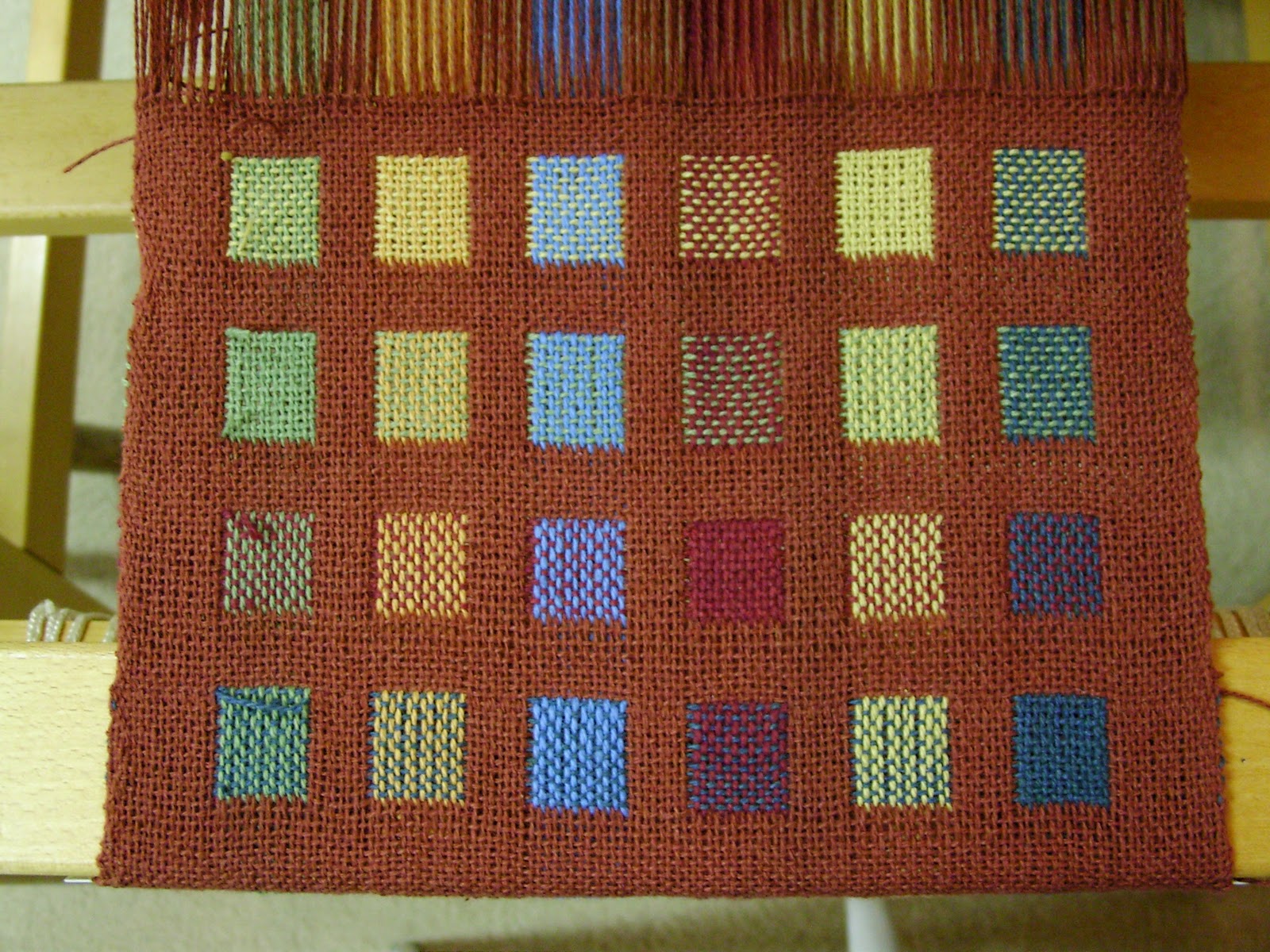
My own weaving on the warp left over is going pretty slowly, since it is being done on my new table loom, an 8 shaft Glimakra Victoria.
I did a little weaving on it tonight after work and dinner.  As can be seen by the length of the sample, it is slow going!
I chose to not weave the squares in the order they were threaded because I didn't want a diagonal line of solid color squares.  They are a little more random, as can be seen if the photo is clicked to enlarge it.  They are the colors I dyed earlier in the month that I wrote about.

Another project that I was working on was a set of 6 placemats.  I finished with the weaving a couple days ago, and finished with the wet finishing and ironing yesterday.  I was going to hem them, but decided to do a simple fringe after they were washed.  I think hems would have been too bulky.

These placemats were part of my effort at stash reduction.  Unfortunately, they hardly put a dent in the stash!

The warp was from a very large cone of 4 ply varigated blue, and the weft was from many cones of yarn used to make chennile bedspreads.  The colors remind me of the old Fiesta dishes from years ago.

I have enough warp left on the loom for another set.  I will think about it a bit, before I start the next set, since I don't want to do the same thing again, and I don't want a lot of yarn color changes, because I hate starting and ending yarn. 


Wednesday, October 6, 2010

Preparing For a Doubleweave Class

After a long hiatus from weaving and writing, I have started preparing for a class I will be taking next week.  Michigan Weaver's Guild
http://www.michiganweaversguild.org/workshops.html
is offering the three daydoubleweave class with Jennifer Moore, author of a new book on doubleweave. 

A friend from downstate told me about it and invited me to stay with her and go to class together.  I'm really looking forward to the class and getting together with other weavers again. 
After checking out the class, I realized I needed a loom with more shafts, so I started looking online and a couple days later, found this sweet loom.
It is a Glimakra Victoria 8 shaft table loom on a stand.  This class is getting expensive already!  I haven't even tried it out yet.  One thing I would like to do with this loom is to convert it to treadles.  If any readers have one like it with treadles, I would value your input on how they are hooked up.  What little I have found about converting, is that the company only makes a kit for the 4 shaft table loom.  I just need to see how they are hooked up, and I think Bob and I could make our own kit.

The doubleweave class is set up as a round-robin, which means everyone weaves samples on other class member's looms.  I received my pattern draft last week, and since that didn't leave enough time to buy more yarn, I am using my stash. 
The pattern calls for seven colors, which I didn't have, so out came the dyes last night. 

Since the beautiful fall season is upon us, I chose a fall color theme. I took the few colors I had of a 6/2 weight cotton and overdyed them to get the colors I wanted.


I finished rinsing them out today after I got home from work, and they are out on the line drying right now.

As soon as they are dry, I will start winding my warp, maybe today, or possibly tomorrow after work.

I love working with color, and trying ones that aren't my favorites.  It keeps me out of a rut, and have actually gotten some new favorites through the dyeing process.