Friday, August 30, 2013

Repairing a Broken Warp Thread on the Loom

I was weaving along on my third towel on my current warp when I noticed a loose thread.  Sure enough, my nice strong warp had a broken warp thread.
Here is the culprit.  A lovable little fuzzball?  NOT!  A bit of fuzz made two of the threads stick together and one broke.  If you need to make the photo bigger, just click on it.
Here is the break by the back beam.
The first step is to isolate the broken warp and heddle.  This one happened to still be threaded.  I used my homemade warp separator, which is simple enough to make, but are available for purchase.  Google search warp separator.


Tie the broken end to the repair piece.
I am generous in cutting the repair piece, so I cut mine with enough to finish the towel I was working on plus some extra.  How much is needed depends on whether the break is in front of or behind the heddles, and how far into the piece the weaving has progressed.

You don't need enough to finish the entire remaining warp.  The object is to get back to using the original warp thread and do away with a dangling weight behind the loom.

Since I am weaving a hand towel that is only about 30" long, I will finish this towel before getting rid of the repair warp and fastening the original warp thread back onto the cloth.

Once the two ends are tied together, I pull the knot through the heddle.
Gently pull the knot through the reed.

I like the flat daisy head pins to attach the broken warp thread to the cloth.  Start the pin about 1/4" away from where the warp thread should be and bring the tip up 1/4" from that.

Wrap the repair warp around the pin 2-3 times in a figure eight and then anchor the tip of the pin in the fabric so it is not exposed to draw blood.
Sometimes photos are a good way to find errors.  As I was viewing my photos, I noticed the last orange weft thread wasn't doubled.   I was able to go back and fix that error and reset my pin.
Finally, go to the back of the loom and tie the other end of the broken warp to the repair warp.  Suspend a weight that gives the same amount of tension as the other warp threads.  An "s" hook works for me.
On a little more personal note, I have had one chemo treatment and my hair is gone.  It started falling out about nine days ago so I had a friend shave it off.  I have been working on crocheting a couple chemo hats (the white and turquoise ones) and my mom knit the pink one for me.

The weather has been pretty warm in Charlevoix, so I have become more comfortable going without a hat.  The cool weather will be coming soon though, and I am thankful for all the nice hats and caps  friends have given me.  They will all get put to good use!

I am feeling fine, my energy is almost back to normal, as is my appetite because my last chemo was over three weeks ago and it has been over six weeks since surgery.  I was supposed to get my next treatment yesterday but it was cancelled because my blood count was too low.  Hopefully it will be up enough to have the chemo next Thursday.  Right now, I am in a self-imposed semi-isolation.  I can't afford to get anyone's germs.  The up side to that is I am getting a fair amount of weaving done.  

Now, back to the loom!


Friday, August 16, 2013

A Good Day for Teaching Weaving

Our son David and his family came for a short visit last night on their way to the UP to go camping.  This morning, while everyone was getting ready to go, I had an opportunity for another teachable moment with granddaughter Morgan.  She got to help me with finishing my last rug on the Weaver's Delight.  When we ran out of fabric for the tubes, I made some more strips and she helped me prepare them into a long strip to load into the tubes.

Here she is on the pink pony, finishing loading a tube.  I think she thought it was a pretty neat tool.
After finishing that project, we heard a commotion outside and walked out to the road to see a car burning a few doors down.  Just a little bit of excitement to start the day!  I have no idea whose car it was or the cause of the fire.  We watched (from a distance) as the fire spread more and more and eventually blew out three of the tires.
 I have had my sister-in-law Mary's Leicester Dryad countermarche loom for several years.  It was the first loom for me to ever use.  She was over recently and I asked her if she was ready to learn to weave.  Since I'm home all the time now, it is easier to fit into our schedules.  After everyone left for camping, we got to business winding a warp for a rayon chenille scarf.

Mary is a great student and grasped the warping concept right away.  I was able to go about my business doing other weaving things while she wound her two bouts of warp.

After we had lunch, we brought the warp to the loom and got it wound on the the back.  Having an assistant certainly makes the warping and winding go faster.  I showed her the back to front method.  We used the lease stick holding device and a 1/2" spacing raddle to spread the warp.

That was about all I was able to do in one day.  I was happy everything went so smoothly.  On Mary's next visit, we will tackle threading and sleying the reed and running a small sample of both plain weave and twill.  I am going to try 20 ends per inch, but think it may be a little too much at least for the plain weave. After doing a little sampling, we may end up resleying the reed to spread it out a little.  I'm looking forward to having someone come weave with me.  My project is on the loom next to hers on the left side of the photo.

If you think this loom looks a little odd, you are right.  It is only good for short warps because the front and back beams are also the cloth beams.  It is not a good loom for long warps because of the thickness that builds up on the beams.  It also doesn't have a brake release, so I will be showing her how live weight tensioning will solve that problem and make the loom very easy to use.

Now I am tired and it is nap time!  All in all, a great day!


Tuesday, August 6, 2013

Making a Repair Heddle and Adding a Warp Thread

Life can change unexpectedly.  Four weeks ago today, I was diagnosed with ovarian cancer.  A week later I had major surgery to remove the masses.  After a week or two of healing and waiting for my chemo to start, I was thankful to have some weaving in the works that wasn't too heavy for me.  It is something I enjoy and can occupy my mind with something other than being sick.  I make dishtowels for all my girls every year for Christmas and I had started that project just before my diagnosis. I had part of it threaded, so was able to pick up where I left off.  I finished the threading, and then..... 

Oops!  I missed a warp thread right in the center of my warp and I discovered that fact after the whole warp was threaded through the heddles.
The loom I am using is my Leclerc Jano table loom.  It has wire heddles, so to do the repair, I need these handy diagonal cutters which are available in any hardware store.
 To get a better view, click on the picture. 

Clip the top and bottom loop on the heddle in the center.
Here is a better view without the cutter in the way.  This is just one of the extra heddles that were pushed off to the side.  Gently remove the cut heddle without unbending the wire too much.
Insert it into the proper spot on the heddle frame.  Tighten the wire loop a bit so it won't slip off.

Prepare a warp thread a bit longer than the other warps and thread it through the repair heddle from the back and incorporate it into the bundle of warp threads where it belongs.

Since everything was threaded, I tied my warp threads on to my front rod at this point.
When everything is tensioned correctly, I take the added warp thread in the back, and wind it around my fingers to take up most of the length.  Wrap some of the warp around the loops, fold it in half and insert an S hook into the to loops.

The warp thread dangles off the back of the loom.
The hook might be enough weight but if not, add fender washers until the right tension is achieved.  It should be the same as the adjacent threads.  If it is too tight, you will notice it when you start to weave because it will pull at the fell line.
 This is a handy little gadget used to spread the warp threads if any break while weaving or if you discover a threading error when you start weaving, or if like me, you miss a warp thread.
Insert it where the error is to hold the adjacent threads out of the way.  I made this today in about 30 minutes with a cedar shim, a utility knife and some sandpaper.  If you prefer to buy one, search for a warp spreader.  I have seen several that are made with nice hardwood.

If I happen to break a warp thread while doing these towels, I will do another post about that type of repair.


Thursday, July 11, 2013

Gypsy Rose, the Second Left-Over Bear

Gypsy Rose was finished at the same time I finished Hamish, but because she was a gift, I didn't write about her right away, and then I got sick and didn't have the energy or desire to write.  I decided today, that I can't wait any longer.  She needs her story told.
As many of the other bears were, she was finished on a trip to visit Bob's parents.  I think she has the sweetest face of all the bears, and just calls out for cuddling.

Hamish is on the left and Gypsy Rose is on the right.
Fortunately, some of the bears live close by, so she got to meet Othar and Benjamin one day when Davey and Bobby brought their bears over to my house.
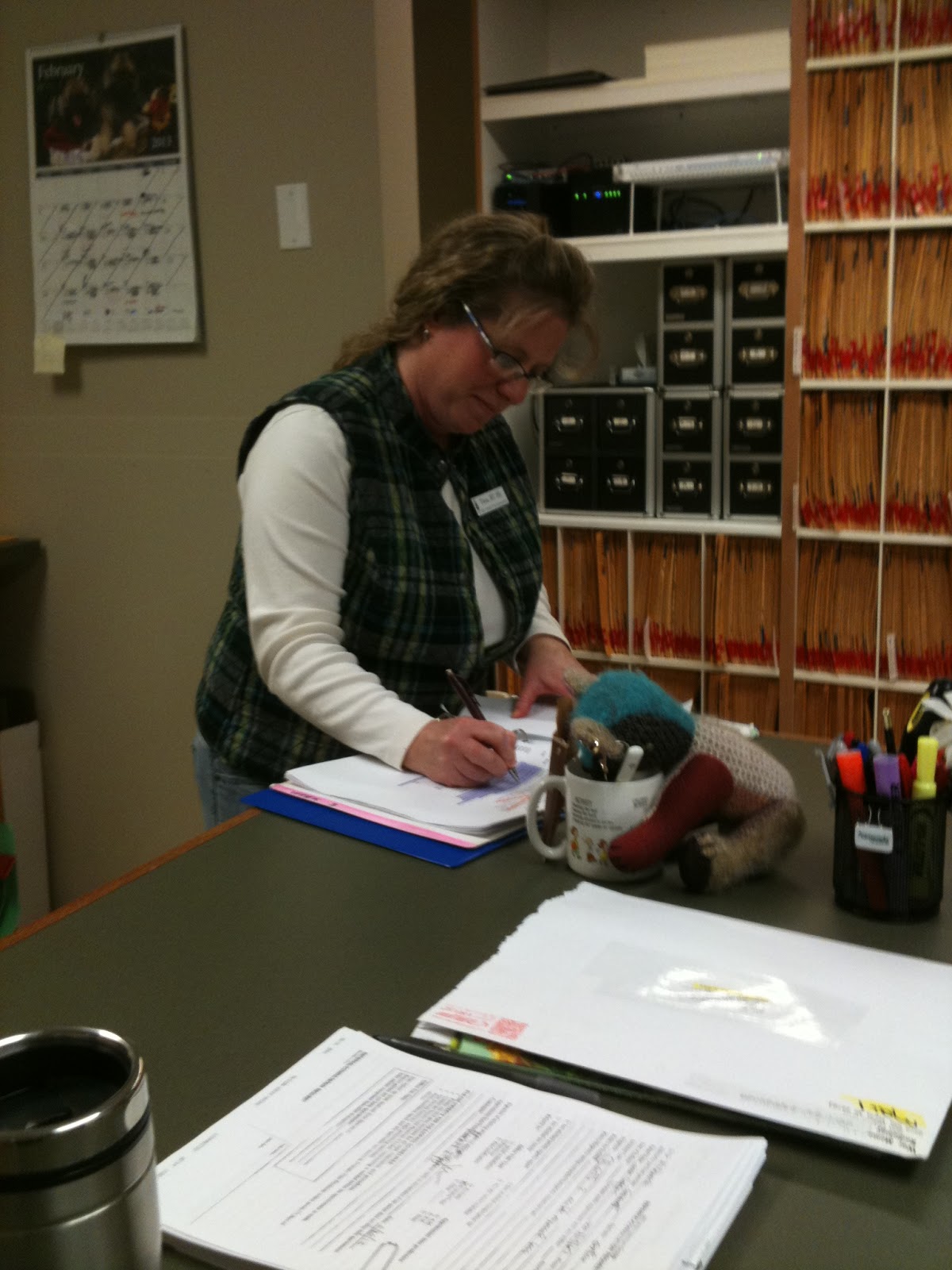
In February,  it was "Take Your Bear to Work Day" at Bay Street Orthopaedics, so I decided to take this bear.  My co-worker Tina helped come up with the name Gypsy Rose.  She is helping Tina with some of her work.  It's a good thing that was just temporary information, because Gypsy got hold of Tina's pen and scribbled all over the paper.
Gypsy Rose is being a little Nosy Parker here, sniffing at one of her favorite foods in the cup.  Tina ended up sharing her oatmeal with her, since it would have been rude to eat in front of a baby bear!

I decided when I started making the last two bears that one would be for my daughter-in-law Jenn's birthday. The trouble was that Jenn's birthday was quite a while after Gypsy Rose was finished.  I started feeling bad that she was the only bear left to be adopted.  One day in April, Jenn called me and said she was in Traverse City, so I quickly wrapped the present and headed to Jenn's mom's house where they were having a ladies family gathering.
Jenn had seen a few photos of Gypsy Rose and was hoping she was going to be for her.  She was surprised and a little teary-eyed when she opened the early birthday gift.
I am so happy Gypsy Rose got to go to a home where she will be loved, and will get to live with four of the Griswold bears.  Hopefully they will all have some wonderful adventures.
Deb, Jenn's mom, also fell in love that night with Hamish.  I let him come along with me so he could see who was going to be Gypsy Rose's mom.
I don't think it is possible to be too old to love a Teddy bear.  I am thankful that all of Griswolds and Left-Overs have such wonderful new homes and mommies and daddies.

These will probably be the last bears.  Maybe their moms and dads will write about more of their adventures.

Friday, July 5, 2013

Weaver's Delight "Pink Pony" Stuffing Machine and Rigby Cutter

I finally got motivated to get back to my blog today.  I was given a "pink pony" stuffing machine by our friend Lou down in Missouri when Bob and I were on vacation in April.  I haven't been feeling well since then, so have only been doing dibs and dabs with weaving lately.  I finally took enough photos to show how I prepare denim strips and load them in the tubes for weaving.

Preparing denim jeans for rugs is labor intensive.  They are plentiful at the resale shops and from friends, so I don't make any effort to open seams, remove pockets, or take out hems.  I trim around all those areas and then make one fairly straight edge on one side.
I purchased a strip cutter on eBay because my hand can't take the heavy cutting for any length of time with the rotary cutter any more.  This particular cutter is a Rigby Cutter.  It is pretty old, but it has been working pretty well for me.  I would have preferred a Fraser Cutter, since there are more options for parts.  They cost more than I was able to spend though.
The red cutter is adjusted away from the cutter blade for the strip width I want.  I use strips that are about 3/4" - 7/8" wide for a twill weave rug.  I would probably cut them 1/2" for plain weave rug.  Anything wider than that and it is almost impossible to get the strips tightly packed. 
Turn the crank and it cuts the strip.
When I get enough strips cut with various colors, I take a bundle of them and sit with them on my lap and cut a 45 degree angle at each end.  I usually do all one end, then flip them around and do the other end.  The angle must be in the same direction at both ends.

Here is a bundle that is probably enough to stuff 2-3 tubes for the shuttles.
I overlap them about 1/4" and triple-stitch zig-zag the ends together.
The strips feed through the shuttle better this way, and I have fewer hang-ups then if I use a 45 degree seam.
I sew them in a continuous strip until it is hard to sew any more.  They loop around in front of the machine and eventually there isn't any more space to sew.

I clip my threads when I'm done sewing and pull them out from under the presser foot.  They will curl into a spiral and that needs to be straightened out before running the strip through the stuffing machine.
The fabric strip is threaded through the eyelet guide in front of the left concave roller, then brought over the top of the roller and drops into the funnel below.  The convex roller is brought forward against the fabric strip. 
As seen in this photo, I straightened my strip into a container on the floor.  While turning the large wheel with the leather belt, the pole is used to poke the strip down into the tube and pack it tight.
Here is a tube loaded into a shuttle.
This rug is getting close to being complete.  Three more tubes will probably be enough. 

I am using a twill tape to keep track of the rug length and the temple that came with the loom to help keep a consistent width to the rug.


Tuesday, April 23, 2013

Hamish Loves His New Clothes

I mentioned before that Bob's bear Hamish is named for one of the characters in the Braveheart movie.  I have had it in the back of my mind for a little while that he needed some clothes to go along with that character.

I wanted to go to Petoskey yesterday to visit my daughter Becky, and asked Bob if I could take Hamish along with me.  He said that was a good idea, since he was going to work and thought it would be good for Hamish to have an adventure.

Becky and I had talked about making the bear a kilt, so she got out her selection of plaid wools and Hamish picked out the pretty blue one.  He knew his daddy would like it because it was a color  he could see (Bob is color blind, but can see blue).

Hamish is sitting here while Becky is cutting the fabric after she took some measurements for his kilt.  She needed a long strip of fabric for pleating.
Hamish is "helping" her pin the pleats.  He learned about sharp pins the hard way!  Ouch!
The pleats were stitched down and then he tried on the kilt.  It looks just about right.  I took it to the ironing board to press the pleats, so it would look nice and swishy when he moves.  Guys and kilts are just about as bad as little girls with their twirly dresses.

While I was pressing, Becky got out her leather, punch, and buckles and created a belt.
She is making the final adjustment before trimming it to the right length.  Hamish is quite proud of his REAL leather belt and big buckle!
Well, isn't he a handsome lad?!
The over the shoulder cloth really adds to the outfit, and pressed pleats really are swishy!
Bob and Hamish both are quite happy with the outfit.  Happy birthday from Becky!
The Left-Over bears and all the other Griswold bears have been one of my favorite projects.

Stay tuned for the story of Gypsy Rose, which will be coming soon.